
Good Governance
Good corporate governance plays a vital role in driving the organization toward effective and sustainable development. It positively impacts regulatory agencies, EGAT’s Board of Directors, executives, employees, and other stakeholders.
Governance Structure and Composition [2-9]
EGAT’s governance structure is transparent and systematic. It comprises the EGAT Board of Directors, appointed by the Cabinet, which is responsible for setting policies and overseeing EGAT’s operations in accordance with the principles of good governance. The Board has also appointed 12 subcommittees to assist in screening and reviewing key matters.
In terms of management, operations are carried out through the EGAT Executive Committee, which includes the Governor of EGAT as the Chief Executive Officer and Chairperson of the Committee, along with Deputy Governors serving as committee members. This structure ensures that EGAT’s operations are efficient and aligned with clearly defined objectives.
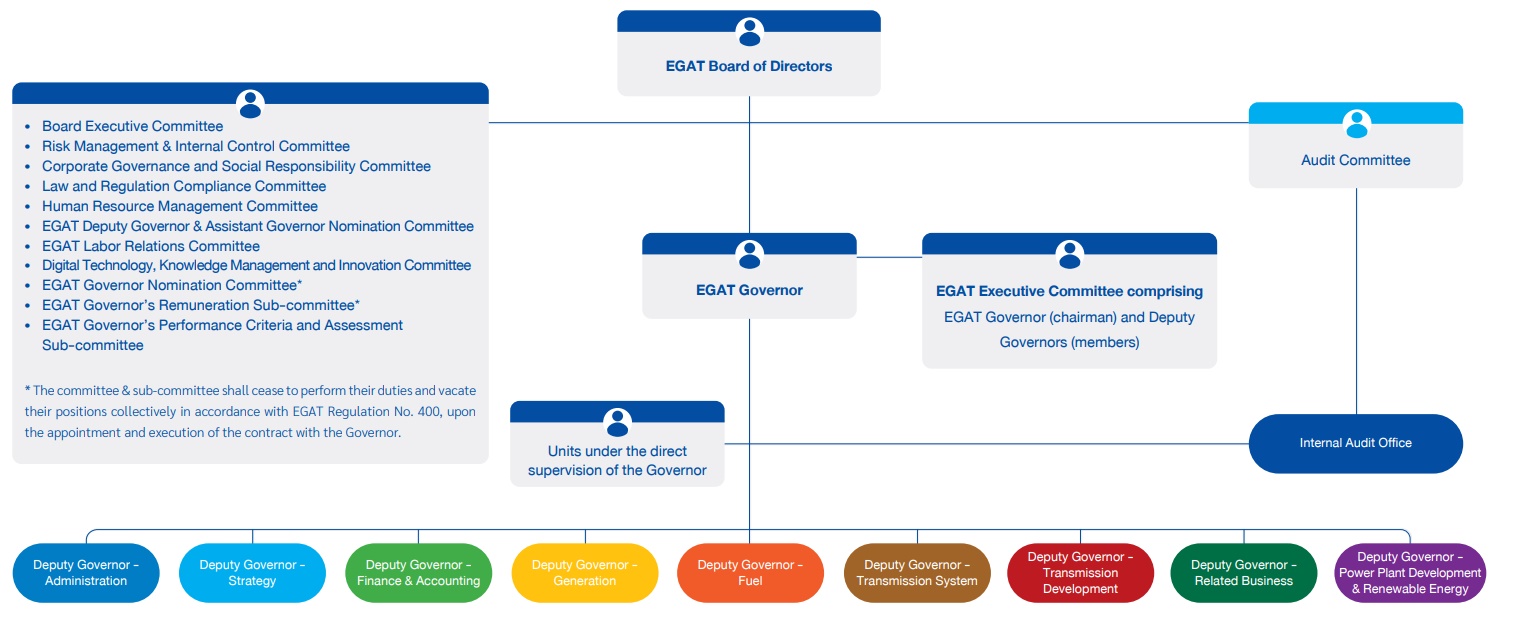
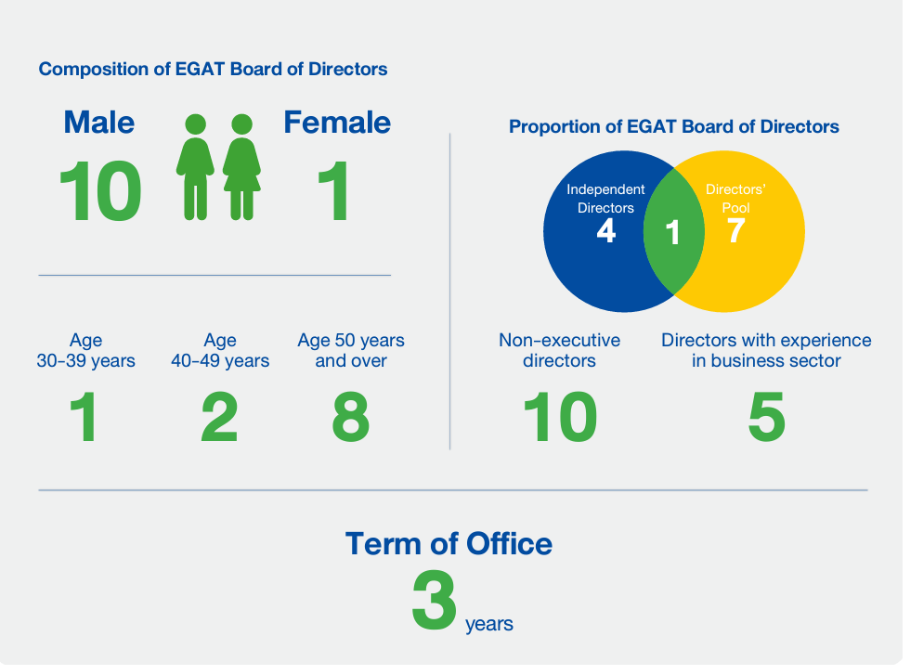
The EGAT Board of Directors consists of a Chairperson and no more than 10 other members, including the Governor, who serves as an ex officio member. Each board member serves a three-year term.
In 2024, the Board comprised 11 members: 10 men and 1 woman. Among them, 4 were independent directors from outside EGAT, possessing autonomy in decision-making and expressing their views. One of these independent directors was listed in the State Enterprise Directors’ Pool (DP), out of a total of 7 EGAT board members included in the DP. This composition aligns with the Principles and Guidelines for Good Governance of State Enterprises (2019) issued by the State Enterprise Policy Office (SEPO), Ministry of Finance, and the Standard Qualifications Act for Directors and Employees of State Enterprises (No.6), B.E. 2550 (2007). Additionally, EGAT complies with the Cabinet Resolution dated 18 July 2017 which mandates that at least one-third of the board members (excluding ex officio members) must be qualified professionals with experience in the business sector.
Nomination and Selection of the EGAT Board of Directors [2-10]
EGAT conducts the nomination and selection of its Board of Directors in accordance with applicable laws and relevant regulations, including the State Enterprise Governance and Management Development Act B.E. 2562 (2019), the resolution of the State Enterprise Policy Committee (SEPC) at its 2/2566 meeting on 25 October 2023 which approved the Skill Matrix and guidelines for the appointment of state enterprise directors, the criteria set by the State Enterprise Directors Screening Committee, the Principles and Guidelines for Good Governance of State Enterprises B.E. 2562 (2019), and other relevant practices.
Key considerations in the nomination and selection process include:
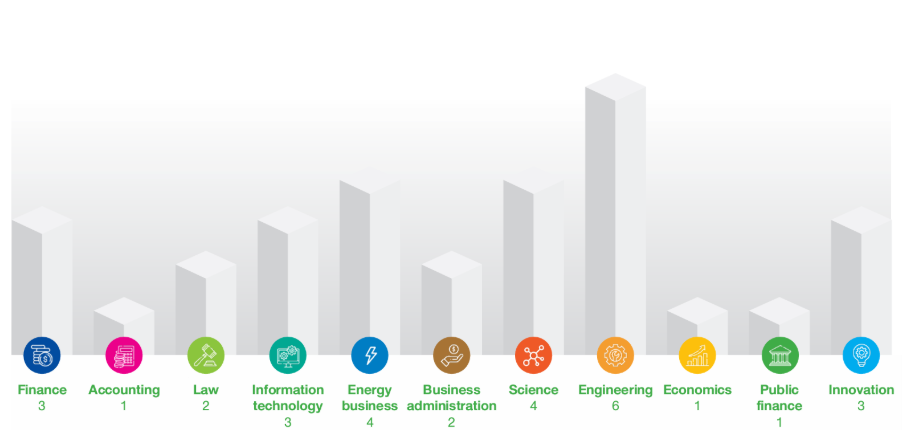
Nominees for EGAT Board membership must be Thai nationals with sufficient expertise in business administration, science, engineering, economics, fiscal policy or law. They must also meet the qualifications and not possess any prohibited characteristics as specified in the Standard Qualifications Act for Directors and Employees of State Enterprises B.E. 2518 (1975) and its amendments.
Chairperson of the EGAT Board of Directors [2-11]
The Chairperson of the EGAT Board serves as the highest-ranking official in the governance function, without holding any executive position within EGAT, thereby ensuring operational transparency and balance. To establish a connection between governance and management, the Board appoints the Governor of EGAT, the organization’s Chief Executive Officer, as the Secretary to the Board in accordance with EGAT Regulation No.373 on Board Meetings and Operations, Article 6, which stipulates that the Chairperson shall appoint the Secretary with the Board’s approval. Furthermore, the Chairperson does not hold any position in EGAT’s subcommittees in compliance with the Principles and Guidelines for Good Governance of State Enterprises B.E. 2562 (2019) and related practices issued by the State Enterprise Policy Office, Ministry of Finance which specify that the Chairperson should not serve on any subcommittees.
Roles of the EGAT Board of Directors [2-12]
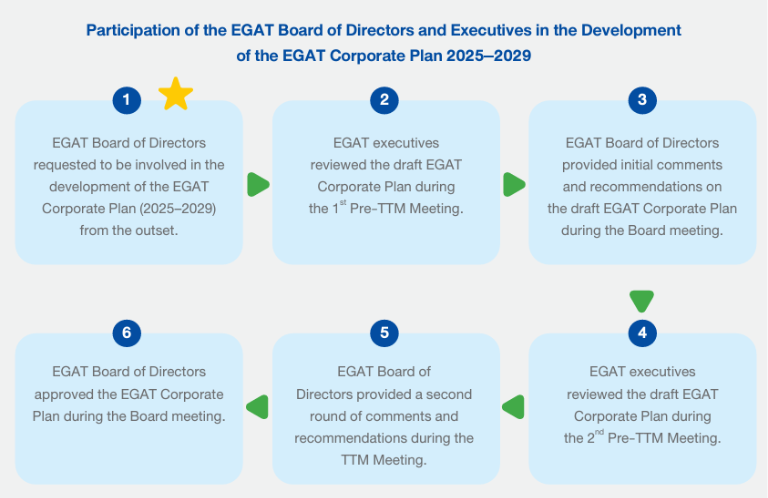
The EGAT Board of Directors, executives and top management of EGAT Group hold an annual Top Team Meeting (TTM) to jointly review EGAT’s vision, mission and strategy. The review incorporates government and regulatory policies, stakeholder needs and expectations, sustainability factors, internal and external conditions and benchmarking data. These are analyzed alongside strategic challenges, advantages and organizational capacity to formulate EGAT’s corporate plan which serves as the operational framework. Additionally, the strategy and implementation approach are reviewed whenever significant external changes occur that may impact EGAT.
In 2024, the EGAT Board of Directors actively participated in the initial phase of drafting the EGAT Corporate Plan for 2025-2029. The Board provided input on the following key focus areas: (1) Piloting a model solar farm under the Environmental, Social and Governance (ESG) Plan (2) Electric vehicles (3) Revenue opportunities from used batteries and solar panels (4) Government policy which has impact on Mae Moh Power Plant (5) Biomass fuel (6) Renewable energy (7) Power system security in Northern Thailand
During the TTM meeting held on 5-6 July 2024, the Board resolved to: (1) Revise EGAT’s strategic positioning to align with national power system security (2) Update the strategic indicators under Strategy S2 to “Supporting Low Carbon and Resilience for Society” (3) Include cross-functional operational data across all dimensions (4) Strengthen alignment between EGAT’s sustainability initiatives and the Dow Jones Sustainability Indices (DJSI)
The management incorporated the Board’s feedback into the draft corporate plan. At EGAT Board Meeting No.9/2024 on 31 July 2024, the Board approved the EGAT Corporate Plan 2025-2029 and agreed to submit it to the Ministry of Energy for endorsement before forwarding it to the State Enterprise Policy Office.
In addition, the Chairperson of the EGAT Board provided operational and governance policy directions to the Board and EGAT executives during the TTM meeting held on 5-6 July 2024. The key policy areas included: (1) governance and oversight of management in accordance with good governance principles (2) sustainable organizational development through ESG (Environment, Social and Governance) and (3) the Bio-Circular-Green Economy (BCG) model such as promoting clean energy, developing infrastructure to support green energy and advancing new forms of energy including hydrogen.
The EGAT Board of Directors has engaged in consultations and fostered relationships with government agencies to ensure the effective management and operation of EGAT’s various functions. Engagement with other stakeholders is overseen by the unit under the Deputy Governor – Strategy which is responsible for implementing the stakeholder engagement action plan and reporting performance outcomes to the Governance and Social Responsibility Committee. This committee reviews the results and reports them to the EGAT Board of Directors on a quarterly basis.
Regarding the review and assessment of the effectiveness of impact management processes in economic, social and environmental dimensions, the Governance and Social Responsibility Committee plays a supervisory role. It monitors and reports performance to the EGAT Board of Directors quarterly and promptly informs the Board of any changes that may affect EGAT’s operations. Additionally, the committee reviews the effectiveness of relevant policies and considers or proposes amendments to the EGAT Regulations on the Governance and Social Responsibility Committee to the Board at least once a year.
Conflict of Interest [2-15]
EGAT places great importance on the prevention of conflicts of interest. Relevant regulations, policies and practices have been established as follows:
- The EGAT Board of Directors is responsible for overseeing and addressing potential conflicts of interest that may arise among Board members, executives and employees. This includes monitoring the misuse of EGAT’s assets.
- The Audit Committee is responsible for reviewing related party transactions or any transactions that may involve conflicts of interest or potential fraud that could impact EGAT’s operations.
- The EGAT Board of Directors, the Governor, and executives at the level of Assistant Governor and above are required to avoid engaging in related party transactions that may lead to conflicts of interest. They must also disclose such transactions at the end of each calendar year, upon appointment or assumption of a new position, or when there are changes during the year. This is done using the “Conflict of Interest and Related Party Transaction Disclosure Form for EGAT Board Members and the Governor” and the “Conflict of Interest and Related Party Transaction Disclosure Form for Executives at the Level of Assistant Governor and Above.” The Internal Audit Office is responsible for reviewing these disclosures and reporting to the Audit Committee for consideration, as well as to the EGAT Board of Directors within the first quarter of the following year.
- Any EGAT Board member with a conflict of interest must abstain from attending or participating in the discussion of the relevant agenda item, such as appointments, remuneration, or performance evaluations.
- Committees responsible for bid evaluation and procurement must verify that all bidders have submitted proposals independently, without collusion or unfair price manipulation. They must also ensure that no EGAT Board members, executives, or employees are involved in the operations of any bidding entities.
Communication of Critical Concerns [2-16]
In cases involving significant concerns, the responsible division will first present the issue to the EGAT Executive Committee for consideration, followed by submission to the relevant subcommittees and the EGAT Board of Directors for review or acknowledgment, as appropriate. In the event of a force majeure incident with potentially severe impacts on society or the nation, the EGAT Governor will immediately communicate the situation and report EGAT’s response actions to the Board.
In 2024, two key concerns were communicated during EGAT Board meetings: (1) The revision of terms in the standard natural gas purchase and sale agreement, effective July 2024, to adopt a net settlement method, allowing same-day offsetting of purchase and sale transactions. (2) Project of Hydro-Floating Solar Hybrid of Bhumibol Dam, unit 2 and unit 3 proposed under EGAT’s fast-track initiative and included in the new Power Development Plan (PDP) to support national policy on increasing renewable energy capacity.
Additionally, concerns were communicated through the Enterprise Performance Management (EPM) system, where Board members could provide comments and suggestions.
Knowledge Enhancement for the Board of Directors [2-17]
EGAT promotes continuous knowledge development for its Board members through annual training programs, seminars, and other activities. In 2024, the Board participated in the following initiatives:
- Introduction Program for newly appointed Board members, including a briefing on the Board’s key roles based on the updated 2024 State Enterprise Assessment Model (SE-AM) by the State Enterprise Policy Office (SEPO), held on 21 February 2024. Participants also received EGAT’s operational handbook covering essential legal and regulatory information.
- Site Visits to the Renewable Energy Forecast Center, Demand Response Control Center and National Power Control Center on 27 March 2024.
- Special Lecture on Driving Sustainable Organization through ESG Initiative by Professor Pisuth Peeramonkul, EGAT Board Member, on 28 August 2024.
- Study Visit to explore EGAT’s new energy business in the United States from 10 to 22 September 2024.
Evaluation of the Performance of the Board of Directors [2-18]
EGAT requires its Board of Directors to conduct an annual self-assessment, in accordance with the Principles and Guidelines for Good Governance of State Enterprises issued by the State Enterprise Policy Office (SEPO), which stipulate that state enterprise boards must perform self-assessments at least once a year.
In 2024, the EGAT Board conducted three types of self-assessments: collective assessment, individual assessment and peer assessment. The assessment questionnaires covered the Board’s roles in overseeing the organization’s economic, environmental and social impacts. All three assessment types yielded results rated as “Excellent Performance.”
Following the assessments, the Board held a discussion to review the results and approved the 2025 Board Governance Enhancement Plan which serves as a framework for continuous improvement to ensure greater efficiency and effectiveness in the Board’s performance.
Remuneration Policy [2-19]
The remuneration of EGAT Board members consists of a monthly retainer and meeting allowances. EGAT adheres to the guidelines issued by the State Enterprise Policy Office (SEPO), Ministry of Finance, regarding board compensation, as approved by the Cabinet Resolution dated 24 April 2019. Under these guidelines, board members of large state enterprises may receive a monthly retainer not exceeding 10,000 baht, while the Chairperson may receive up to 20,000 baht per month, prorated based on the duration of service. Meeting allowances are provided only in months when meetings are held, with board members receiving up to 20,000 baht and the Chairperson up to 25,000 baht per meeting. In justified cases, more than one meeting allowance may be paid per month but not exceeding 15 times per year. If a board member serves on more than one board, the total meeting allowances must not exceed those of two boards, with a maximum of one meeting per board per month. All board members are responsible for their own personal income tax obligations.
For senior executives, remuneration includes: (1) compensation for the Chief Executive Officer (Governor), which is determined by a subcommittee responsible for evaluating and negotiating the Governor’s salary and benefits, drafting the employment contract and submitting recommendations to the EGAT Board. Another subcommittee is appointed to establish performance criteria and evaluate the Governor’s performance based on the contract framework before presenting the results to the Board. (2) Compensation for other senior executives such as Division Directors and equivalent positions, is based on EGAT’s salary structure and includes a fixed-rate bonus applicable across the organization, subject to the enterprise’s performance and Ministry of Finance criteria.
The EGAT Board is responsible for setting policies and overseeing operations to ensure the achievement of strategic goals across economic, environmental and social dimensions. These goals are translated into master plans and action plans which are systematically linked to the remuneration and incentive structures for both the Board and senior executives.
Regarding retirement compensation, Board members do not receive any gratuity upon retirement. However, senior executives are entitled to retirement benefits based on their years of service in accordance with legal provisions applicable to regular employees.
EGAT, as a state enterprise, is eligible to allocate bonuses to its board members and employees when there is distributable profit. EGAT follows the incentive system guidelines under the performance evaluation framework for state enterprises issued by the State Enterprise Policy Office (SEPO), Ministry of Finance. These guidelines include criteria for bonus allocation based on distributable profit, performance evaluation results and specific conditions for board member bonuses.
● The base bonus rate for EGAT board members is determined by the level of distributable profit as follows:
| Distributable profit (Million baht) | Bonus (baht per person) |
| Up to 100 | 3% of distributable profit but not exceeding 60,000 |
| 100 – 300 | 65,000 |
| > 300 – 500 | 70,000 |
| > 500 – 700 | 75,000 |
| > 700 – 1,000 | 80,000 |
| > 1,000 – 2,000 | 90,000 |
| > 2,000 – 5,000 | 100,000 |
| > 5,000 – 8,000 | 110,000 |
| > 8,000 – 11,000 | 120,000 |
| > 11,000 – 13,000 | 130,000 |
| Every 2,000 increase in profit | Additional 10,000 |
Notes:
● Bonus allocation based on performance evaluation is also applied as follows:
| Evaluation Score | Bonus (baht per person per year) |
| 5.00 (Excellent) | Base + 100% of base |
| 4.50 | Base + 75% of base |
| 4.00 (Very Good) | Base + 50% of base |
| 3.50 | Base + 25% of base |
| 3.00 (Good) | base |
| 2.50 | Base – 25% of base |
| 2.00 (Fair) | Base – 50% of base |
| 1.50 | No bonus |
| 1.00 (Needs Improvement) |
- Specific Conditions:
- Bonuses may be paid only after EGAT has remitted the distributable profit to the national revenue, or has received approval from SEPO for deferred payment with a clearly defined schedule.
- In cases of operational losses or absence of distributable profit, bonuses may be paid only based on performance evaluation results.
- Bonuses may be paid only after the financial statements have been audited and certified by the Office of the Auditor General, and the bonus allocation has been approved by SEPO.
- EGAT Board members are responsible for their own personal income tax obligations.
Remuneration Determination Process [2-20]
The determination of remuneration for the EGAT Board of Directors is in accordance with the Cabinet resolution and the criteria established by the Ministry of Finance. No consultants have been appointed in this regard.
For the highest-ranking executive, the Governor, a subcommittee is appointed comprising one independent director to determine salary and benefits, set remuneration criteria and guidelines, draft the employment contract, negotiate terms and submit proposals to the EGAT Board of Directors for consideration. Another subcommittee is responsible for reviewing the Governor’s operational plans and performance indicators in accordance with the employment contract framework, and for conducting performance evaluations. The EGAT Board of Directors participates in a 360-degree electronic evaluation every six months, the results of which are submitted to the Board for review.
For other senior executives, Deputy Governors, the remuneration process aligns with performance outcomes based on policy and performance evaluation agreements. According to Section 22 (1) of the Electricity Generating Authority of Thailand Act B.E. 2511 (1968), any salary or wage increases for employees or officers at the level of Advisor, Expert, Division Director or equivalent and above must be approved by the EGAT Board of Directors.
EGAT’s remuneration framework incorporates human resource and management policies, employee demands (via the labor union or EGAT’s labor relations committee), engagement survey results, changes in laws or government policies and external compensation benchmarks. These factors are analyzed to develop remuneration proposals for the EGAT Executive Committee and Board of Directors in cases involving existing financial employment conditions. For new or exceptional conditions, approval must be obtained from the State Enterprise Labor Relations Committee and the Cabinet.
Good Governance and Anti-corruption
EGAT has announced its corporate governance and anti-corruption policy as a framework for conducting operations with integrity, transparency, fairness, accountability and zero tolerance for all forms of corruption. It has also implemented policy on governance, risk management and compliance (GRC), requiring all levels of management to lead by example in ethical conduct and adherence to laws and regulations. EGAT promotes active participation from employees at all levels and strictly prohibits any form of corrupt practices. The organization has established a code of ethics for its Board of Directors, executives and employees, along with an ethics and conduct manual and professional code of conduct which set behavioral standards. These are supported by operational mechanisms and systems to ensure effective enforcement including disciplinary procedures based on the severity of misconduct.
The Governor of EGAT has declared a strong commitment to ethical and transparent management, emphasizing operations guided by EGAT’s corporate governance principles. This includes fostering an organizational culture of integrity and zero tolerance for corruption, promoting awareness of the distinction between personal and public interests, and implementing policies and guidelines on the giving and receiving of gifts to prevent conflicts of interest and potential bribery. EGAT also regularly reviews its operational processes to ensure clarity, transparency and accountability, and maintains readiness for both internal and external audits. These efforts aim to mitigate risks related to corruption and reinforce a culture of ethical conduct throughout the organization.
EGAT encourages its Board of Directors, executives, and employees to actively engage in operations with integrity and fairness. Key initiatives include:
EGAT has established the Anti-Corruption Operations Center to oversee and enhance the effectiveness of its anti-corruption initiatives. The center promotes adherence to EGAT’s Corporate Governance and Anti-Corruption Policy through the Corporate Governance Master Plan and the Action Plan for Governance Promotion and Anti-Corruption, which are implemented across all departments. Progress is monitored and reported quarterly to the Governance and Social Responsibility Committee and the EGAT Board of Directors.
The center also develops guidelines and manuals on governance and anti-corruption, analyzes issues, obstacles and risks related to corruption, and reports findings to the Governance and Social Responsibility Committee.
In cases of suspected misconduct, EGAT appoints a fact-finding committee. If serious disciplinary violations are found, the supervisor of the accused employee must appoint a disciplinary investigation committee. Proven misconduct may result in penalties ranging from dismissal to termination, depending on the severity and impact on EGAT.
Complaint Mechanism
EGAT places great importance on receiving feedback, complaints, and suggestions from all stakeholder groups to improve operations and address both direct and indirect impacts arising from its mission, in line with good governance principles. The EGAT Feedback Management Center serves as the central unit for handling complaints. EGAT has also appointed the Complaint and Anonymous Letter Review Committee to manage cases involving corruption, serious disciplinary violations, and anonymous reports. Additionally, the EGAT Anti-corruption Operations Center supports, promotes, and monitors compliance with EGAT’s complaint and anti-corruption management processes.
EGAT provides 6 official channels for receiving complaints and suggestions from stakeholders: (1) letters submitted to EGAT (2) the Government Complaint Management System (1111) (3) EGAT website (4) the Feedback and Complaint Management System (5) the Customer Voice System and (6) the EGAT Information Service Center (Call Center 1416). These channels are actively promoted through emails, brochures, stickers and video clips to ensure stakeholders are aware of how to access EGAT’s complaint mechanisms.
Upon receiving a complaint, EGAT provides an initial response to the complainant via email or letter to confirm receipt and inform them that the matter is being coordinated with the relevant department. If the issue is unrelated to EGAT or its personnel, the EGAT Feedback Management Center forwards the case to the appropriate agency. Stakeholders can track progress through EGAT’s Feedback and Complaint Management System until resolution, with formal notifications issued upon closure.
In cases involving corruption, serious disciplinary violations or anonymous reports, the Secretary of the Complaint and Anonymous Letter Review Committee forwards the matter to the responsible unit for fact finding. A fact-finding committee is appointed and the results are reported back to the Secretary.
If the complaint is found to be unsubstantiated, the unit is instructed to resolve the issue appropriately to foster understanding among staff and close the case. If a complaint is found to have merit involving disciplinary misconduct, the supervisor of the accused employee appoints a committee to investigate minor disciplinary violations. If misconduct is confirmed, the supervisor issues a disciplinary order, with penalties ranging from a warning, salary deduction or reduction, dismissal (for permanent staff), termination (for contract staff), to removal, depending on the severity and impact of the violation. For complaints not involving disciplinary misconduct, the responsible unit must resolve the issue appropriately. To ensure transparency, fairness and credibility, EGAT reports the outcomes of complaint management to senior executives, the Anti-Corruption Operations Center and the Governance and Social Responsibility Committee.
EGAT ensures the protection of the rights of complainants, whistleblowers, and witnesses who submit information through the EGAT Feedback Management Center or via the Complaint and Anonymous Letter Review Committee. All personal data and identifying information are kept strictly confidential and disclosed only when necessary for complaint resolution. Responsible personnel are required to sign confidentiality agreements related to the complaint management system.
Stakeholders may also submit anonymous complaints through representatives or third parties. If the identity of the complainant cannot be verified, the complaint is treated as anonymous and processed under the procedures of the EGAT Feedback Management Center or via the Complaint and Anonymous Letter Review Committee.
EGAT conducts annual satisfaction surveys among users of its complaint management system and holds regular meetings with system administrators to identify challenges and areas for improvement. These insights are used to continuously enhance the system.
Beyond complaint mechanisms, EGAT also engages in proactive efforts to minimize actual and potential impacts, such as communicating with communities to build understanding about EGAT’s operations and listening to their concerns for further improvement
Performance in 2024
Assessment of Corruption-related Risks [205-1]
| Identified and significant risk | EGAT operational lines subject to risk assessment concerning corruption | |
| Number | % | |
| 1. Unintentional or negligent violation of laws, regulations, or rules by employees (excluding cases related to accidents) 2. Abuse of authority for personal gain or for the benefit of associates 3. Misuse of EGAT’s assets or supplies for personal benefit | 9 | 100 |
Communication and training about anti-corruption policies and procedures [205-2]
| Target Group | Those who have been communicated on policy and practice in anti-corruption | Those who have been trained in anti-corruption | ||
| Number | % | Number | % | |
| EGAT Employees | 15,295 | 100 | 857 | 5.60 |
| Classified by group | ||||
| – Senior executive (Level 12 and above) | 127 | 0.83 | 14 | 0.09 |
| – Executive (Level 8-11) | 4,635 | 30.30 | 407 | 2.66 |
| – Operation staff (Below level 8) | 10,533 | 68.87 | 436 | 2.85 |
| Classified by region | ||||
| – Central | 6,430 | 42.04 | 392 | 2.56 |
| – Regional | 8,865 | 57.96 | 465 | 3.04 |
| Trading partners | 21,871 | 100.00 | – | – |
| Classified by type | ||||
| – Procurement according to the Public Procurement and Supplies Administration Act | 14,624 | 66.86 | – | – |
| – Commercial procurement | 7,247 | 33.14 | – | – |
| Classified by region | ||||
| – Overseas | 195 | 0.95 | – | – |
| – Central | 8,008 | 39.17 | – | – |
| – Regional | 12,241 | 59.88 | – | – |
Note: Percentage is based on the total number of each group
Confirmed incidents of corruption and actions taken [205-3]
| Type of corruption | Number of incidents | Number of incidents in which employees were punished | Number of incidents when contracts with business partners were terminated or not renewed | Public legal cases | Actions taken |
| Falsely claiming travel expenses for personal reimbursement, and using EGAT vehicles to transport unauthorized individuals | 2 | 2 | 0 | 0 | – |
Complaints
| Category | Number (case) | % | Resolved (case) | In process (case) |
| 1. Allegations of corruption from the public or EGAT personnel, including abuse of authority, can cause serious damage to EGAT or negatively impact the organization’s reputation | 2 | 0.98 | 1 | 1 |
| 2. Complaints related to procurement processes | 20 | 9.76 | 17 | 3 |
| 3. Complaints regarding EGAT’s operations that affect the quality of life of the public or are submitted by customers through the Voice of Customer (VOC) system | 83 | 40.48 | 71 | 12 |
| 4. Complaints concerning management practices, employee conduct, or behavior that may negatively affect EGAT’s image | 100 | 48.78 | 87 | 13 |
| Total | 205 | 100 | 176 | 29* |
Notes: As of 31 December 2024