
Occupational Health and Safety
EGAT places importance on conducting its operations based on occupational health and safety principles, as these help reduce and control risks that may lead to workplace accidents. This contributes to minimizing losses related to personnel, including employees, contractors, and relevant stakeholders, as well as assets and disruptions to critical operational processes that could affect business continuity, organizational reputation, and credibility.
| Target for 2025 | Performance |
| ● Injury Frequency Rate (IFR) for employees reduced by 40% from the previous year (2024 = 0.436) | ● Injury Frequency Rate: 0.381, decreased by 12.61% from the previous year |
| ● Injury Severity Rate (ISR) for employees reduced by 40% from the previous year (2024 = 436.60) | ● Injury Severity Rate: 364.61, decreased by 16.49% from the previous year |
| ● 100% of employees with abnormal health check results receive follow-up and recommendations | ● 100% of employees with abnormal health check results received follow-up and recommendations |
Policy and Commitment
EGAT has established policies on quality, security, safety, occupational health, and environment, which are applied as organization-wide guidelines to ensure effective compliance with applicable laws, regulations, rules, and requirements.
Operational Structure
EGAT’s Board of Directors is responsible for overseeing fair and appropriate practices toward all stakeholder groups in accordance with laws and standards, including occupational health and safety considerations. At management level, EGAT has established dedicated units responsible for safety management, including the Safety and Security Division, regional safety and security units, and safety officers at all levels. In addition, several committees and working groups oversee occupational health and safety performance, including:
- The Operational Risk and Safety Oversight Committee, responsible for setting direction, supervising, and monitoring operational risk, safety, and security performance
- The Operational Risk and Safety Audit Working Group, responsible for auditing high-risk units
- The Severe Accident Investigation Working Group, responsible for analyzing root causes of major accidents with significant impacts and summarizing findings
Furthermore, the Medical and Health Division is responsible for healthcare services, health promotion, and environmental health management.
Management Approach
Occupational health and safety management system
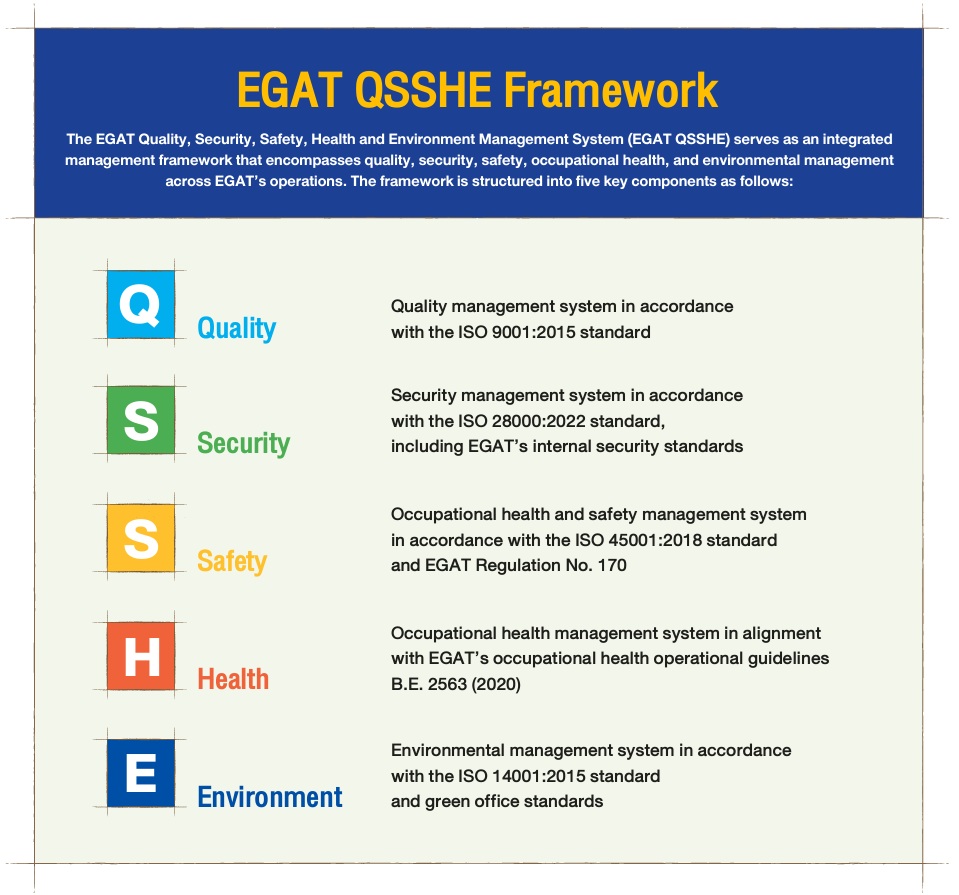
EGAT manages occupational health and safety under the EGAT Quality, Security, Safety, Health and Environment Management System (EGAT QSSHE), which comprehensively covers the operations of employees, contractors, and all stakeholder groups of EGAT. The system ensures compliance with applicable laws, regulations, rules, and requirements, including the Occupational Safety, Health and Environment Act B.E. 2554 (2011), ministerial regulations on safety management standards B.E. 2565 (2022), and the Occupational Health and Safety Management System standard (ISO 45001:2018).
EGAT systematically monitors and evaluates the efficiency and effectiveness of its occupational health and safety performance. This includes the establishment of audit criteria, qualifications of auditors, audit planning, scheduling, reporting, and follow-up on corrective actions. Audits are conducted annually and are classified into: (1) External audits and certification under ISO 45001 for business units responsible for EGAT’s core operations, such as power generation, transmission systems, and fuel operations, which involve significant hazards and high risks, and (2) Internal audits under the EGAT QSSHE system for all units that do not obtain external certification, conducted through self-assessment via the Audit Management system.
In addition, units with safety risks and environmental concerns are subject to site condition assessments by EGAT internal auditors. In cases where deficiencies are identified, corrective and preventive actions are monitored, and key findings are further discussed in management review meetings.
Hazard identification, risk assessment, and incident investigation
EGAT conducts hazard identification and risk assessment, including environmental aspects, for both routine and non-routine operations. These processes comprehensively cover all stages of work performed by employees, contractors, and stakeholders within the scope of responsibility of each unit, with the aim of reducing and controlling risks across all work processes that may lead to injuries, illnesses, or loss of life and property. This is supported by the use of a web application for Risk Assessment and Environmental Aspects (RAEA).
Hazard identification and occupational health and safety risk assessment consist of the following steps:
- Identification and classification of hazards based on activities, locations, and nature of work
- Risk assessment by considering likelihood and severity
- Prioritization to establish appropriate risk control measures or action plans
- Monitoring, control, and evaluation of risk management measures or action plans, including reporting performance results to management for continuous review and improvement of operational procedures
The results of risk and environmental aspect assessments are applied in planning and operational control, such as the establishment of policies, objectives, and action plans, as well as the determination of control measures within regulations, key operational processes, and work procedures of relevant units. In addition, if employees, contractors, or stakeholders assigned to perform tasks identify that working conditions or tasks involve high or severe risks that cannot be mitigated independently, they have the right to refuse unsafe work.
EGAT has also established guidelines for incident reporting and investigation of incidents that may result in or lead to injuries, illnesses, occupational diseases, property damage, and production-related accidents, covering all operational activities within responsible areas and nearby communities. These guidelines apply to employees and all stakeholders and include incident reporting, root cause investigation, incident analysis, assessment of accident-related costs, and incident communication. Furthermore, all units are required to review risk assessments and environmental aspects whenever incidents, near-miss events, or environmental impact incidents occur, to ensure continuous improvement and enhanced preventive measures.
Occupational health services and health promotion
- Annual health check-ups and risk-based medical examinations are provided to employees at least once per year. The examination scope is determined in accordance with the criteria set by the Medical and Health Division for general health examinations, risk-based health examinations, and health examinations for special types of work.
- Health fitness assessments are conducted for employees performing specialized or high-risk tasks.
- Follow-up and health advisory services are provided to ensure that employees maintain adequate health conditions for effective job performance.
- Fitness-for-duty evaluations are conducted prior to employees returning to work after injury or illness, in compliance with legal requirements.
- Health surveillance is conducted for employees exposed to high noise levels, along with recommendations to relevant units for implementing hearing conservation programs in accordance with regulations issued by the Department of Labour Protection and Welfare. In cases where hearing abnormalities are detected, employees are provided with guidance or referred for further medical diagnosis.
- Employee participation in personal health care is promoted through various initiatives, including:
- EGAT Healthy Idol Program: a 90-day weight reduction competition featuring training on nutrition and exercise, physical fitness assessments, and continuous progress monitoring
- Self–health Promotion Program: training sessions focused on the “3E principles”, Eating, Emotion, and Exercise
- EGAT Step Challenge: a walking competition that tracks step counts via a mobile application
These initiatives aim to enhance employees’ overall health and well-being while fostering a culture of proactive health management across the organization.
Participation, consultation, and communication on occupational health and safety
- The EGAT QSSHE management system establishes requirements for participation, consultation, and communication with employees and stakeholders regarding occupational health and safety operations. Examples include providing opportunities and encouraging employee participation in quality, safety, health, and environmental activities; consulting employees on improvements to safety equipment or control measures; and involving employees in actions related to serious accidents and high-potential incidents. In addition, communication is carried out to raise awareness of occupational health and safety and to foster a safety culture across the organization through various media, such as posters, video clips, and pre-meeting safety briefings.
- EGAT has established Occupational Safety, Health, and Work Environment Committees covering all operational areas. These committees consist of 50% employee representatives and 50% employer representatives and meet once a month. Their key responsibilities include formulating occupational health and safety policies, establishing measures to prevent and reduce accidents, injuries, illnesses, and work-related disturbances, reporting and recommending improvements to working conditions and work environments, reviewing safety training programs, and monitoring, evaluating, and reporting annual performance.
- Occupational health coordinators are assigned to all organizational units, both at headquarters and in regional offices. They are responsible for supporting occupational health services and related activities, such as ensuring employees undergo health check-ups. Annual meetings of occupational health coordinators are organized at least once per year to encourage participation, gather feedback, and enhance understanding of roles and responsibilities in occupational health management. In addition, dedicated communication channels have been established for disseminating information, public relations, inquiries, and consultations related to occupational health services.
Occupational health and safety training
In 2025, EGAT provided occupational health and safety training programs for employees in compliance with legal requirements and occupational health and safety management standards. These included training courses such as Safety Officer programs at management and supervisory levels, as well as courses on safety, occupational health, and working environment for general employees and newly hired personnel. In addition, job-specific safety training aligned with operational risk levels was conducted.
A total of 147 training sessions were held, with 6,732 participants attending. Furthermore, EGAT organized the EGAT Safety Together 2025 event to promote a safety culture in the workplace. The event featured keynote lectures by distinguished speakers, presentations of employee safety performance, and recognition awards for outstanding safety achievements.
In addition, EGAT enhanced employees’ health awareness through various training programs, including occupational diseases (such as noise and chemical hazards, office syndrome, and shift worker health care), basic life support, first aid, and the use of Automated External Defibrillators (AED). Public communication materials were also disseminated on relevant health topics, such as PM2.5 situations, post-earthquake health impacts and safety practices, and mosquito-borne diseases during the rainy season.
Occupational health and safety management for contractors
EGAT has established regulations on contractor safety management, defining safety-related activities that both the employer and contractors must implement throughout all stages, including contractor selection, pre-work preparation, work execution, work handover, inspection, and performance evaluation.
These regulations encompass key safety requirements, such as incorporating safety conditions into procurement terms, conducting pre-work meetings with contractors to communicate safety policies and practices, and requiring contractors to prepare and submit safety plans for review prior to commencing work. Contractors are also required to conduct health checks for workers based on risk factors and ensure the use of appropriate personal protective equipment (PPE) during operations.
In the event of accidents involving contractor personnel, investigations are conducted to determine root causes in accordance with EGAT’s incident management procedures.
Occupational Health and Safety Training for Contractors’ and Subcontractors’ Employees
| Activity | Total workdays of contractors’ and subcontractors’ employees (days) | Total employees of contractors and subcontractors (persons) | Contractors’ and subcontractors’ employees receiving occupational health and safety training (persons) | Percentage of contractors’ and subcontractors’ employees receiving occupational health and safety training (%) |
| Power plant and transmission system construction | 8,295 | 2,678 | 2,678 | 100 |
| Power plant and transmission system operations | 26,901 | 10,835 | 10,835 | 100 |
| Maintenance | 35,680 | 5,369 | 5,369 | 100 |
| Mining | 365 | 4,400 | 4,400 | 100 |
Note: Training programs for contractors’ employees are carried out in accordance with applicable laws.
Occupational health and safety statistics
| Item | Unit | 2025 | 2024 | 2023 |
| Workers covered by the occupational health and safety management system | ||||
| Persons covered by the occupational health and safety management system | ||||
| Employees | Persons | 14,943 | 14,875 | 15,312 |
| % | 100 | 100 | 100 | |
| Contractor employees | Persons | 3,943 | 3,951 | 3,888 |
| % | 100 | 100 | 100 | |
| Persons covered by the occupational health and safety management system verified by an internal body | ||||
| Employees | Persons | 5,456 | 5,511 | 7,277 |
| % | 36.51 | 37.05 | 47.51 | |
| Contractor employees | Persons | 1,122 | 1,143 | 1,059 |
| % | 28.46 | 28.93 | 27.24 | |
| Persons covered by the occupational health and safety management system verified by an external body | ||||
| Employees | Persons | 9,487 | 9,364 | 8,040 |
| % | 63.49 | 62.95 | 52.49 | |
| Contractor employees | Persons | 2,821 | 2,808 | 2,829 |
| % | 71.54 | 71.07 | 72.76 | |
| Work-related injuries | ||||
| Hours worked | ||||
| Employees | Hours | 23,627,895 | 27,489,000 | 28,296,576 |
| Contractor employees | Hours | n/a | n/a | n/a |
| Fatalities | ||||
| Employees | Persons | 1 | 2 | 1 |
| Persons/1,000,000 hours worked | 0.0423 | 0.0728 | 0.03534 | |
| Contractor employees | Persons | 0 | 1 | 1 |
| Persons/1,000,000 hours worked | n/a | n/a | n/a | |
| High-consequence work-related injuries (excluding fatalities) | ||||
| Employees | Persons | 1 | 1 | 0 |
| Persons/1,000,000 hours worked | 0.0423 | 0.0364 | 0 | |
| Contractor employees | Persons | 0 | 0 | 7 |
| Persons/1,000,000 hours worked | n/a | n/a | n/a | |
| Recordable work-related injuries | ||||
| Employees | Persons | 42 | 30 | 31 |
| Persons/1,000,000 hours worked | 1.7776 | 1.0913 | 1.0955 | |
| Contractor employees | Persons | 0 | 12 | 27 |
| Persons/1,000,000 hours worked | n/a | n/a | n/a | |
| Work-related ill health | ||||
| Fatalities due to work-related ill health | ||||
| Employees | Persons | 0 | 0 | 0 |
| Persons/1,000,000 hours worked | 0 | 0 | 0 | |
| Contractor employees | Persons | 0 | 0 | n/a |
| Persons/1,000,000 hours worked | 0 | 0 | n/a | |
| Recordable work-related ill health | ||||
| Employees | Persons | 0 | 0 | 0 |
| Persons/1,000,000 hours worked | 0 | 0 | 0 | |
| Contractor employees | Persons | 0 | 0 | n/a |
| Persons/1,000,000 hours worked | 0 | 0 | n/a | |
Notes: