
Demand-side Management
Demand Side Management has been an ongoing mission of EGAT for more than 30 years. EGAT campaigns for electricity users across all sectors to use electricity and resources as efficiently as possible by promoting high-efficiency electrical equipment and systems, encouraging energy efficiency measures, and fostering positive attitudes that lead to behavioral change in electricity use.
This measure supports the growth of society and the Thai economy, which continue to increase national electricity demand, while also helping electricity users in the public sector, industrial sector, and residential sector reduce energy costs, reduce greenhouse gas emissions from electricity generation, and mitigate environmental impacts, thereby moving toward carbon neutrality and contributing tangibly to climate change mitigation.
| Targets for 2025 | Performance |
| ● Reduction of electricity consumption by 8,251 GWh | ● Reduction of electricity consumption by 8,471.27 GWh |
| ● Reduction of greenhouse gas emissions by 4.303 million tCO2 | ● Reduction of greenhouse gas emissions by 4.417 million tCO2 |
| ● The integration and nationwide standardization of energy efficiency labeling measures for high-efficiency machinery, equipment, and energy conservation materials, in collaboration with the Department of Alternative Energy Development and Efficiency (DEDE) | ● The signing of a cooperation agreement to study integration approaches for energy efficiency labels for high-efficiency machinery, equipment, and energy conservation materials with DEDE, and officially launched the integrated energy efficiency label format on 23 September 2025 |
Management
EGAT implements demand-side management under Triple E strategies as follow:
1. Energy Saving Equipment
have played a key role in driving the electrical equipment market by encouraging manufacturers, importers, and distributors to produce and supply high-efficiency products. EGAT has developed energy performance standards and implemented the No.5 Energy Efficiency Label, supported by marketing strategies to promote consumer adoption of high-efficiency.
In 2025, EGAT collaborated with the Department of Alternative Energy Development and Efficiency (DEDE) to study integration approaches for energy efficiency labels for machinery, equipment, and energy conservation materials, and to develop a unified label format and national standard to raise Thailand’s energy management standards to the international level. The new No. 5 Energy Efficiency Label covers 45 products, including electrical appliances and other products, and will begin to be marketed from 16 January 2026 onward. The label has the following characteristics:
- A 1–5 star rating system, providing consumers with more options for highly efficient and energy-saving appliances
- A blue circular ring around the No. 5, symbolizing the power of circulation and the return of benefits to consumers and the planet
- Display of the lifetime carbon dioxide emissions reduction, enabling consumers to participate in global warming mitigation through their choice of No. 5 Energy Efficiency Label electrical appliances
- A symbol indicating Circular Economy process, expanding the role of the No. 5 Energy Efficiency Label from the point of purchase to the full life cycle of the product
- A QR code to provide consumers with further information on electrical appliances, namely usage, installation, maintenance, and other useful information
- The logos of the principal certification bodies, both EGAT and DEDE
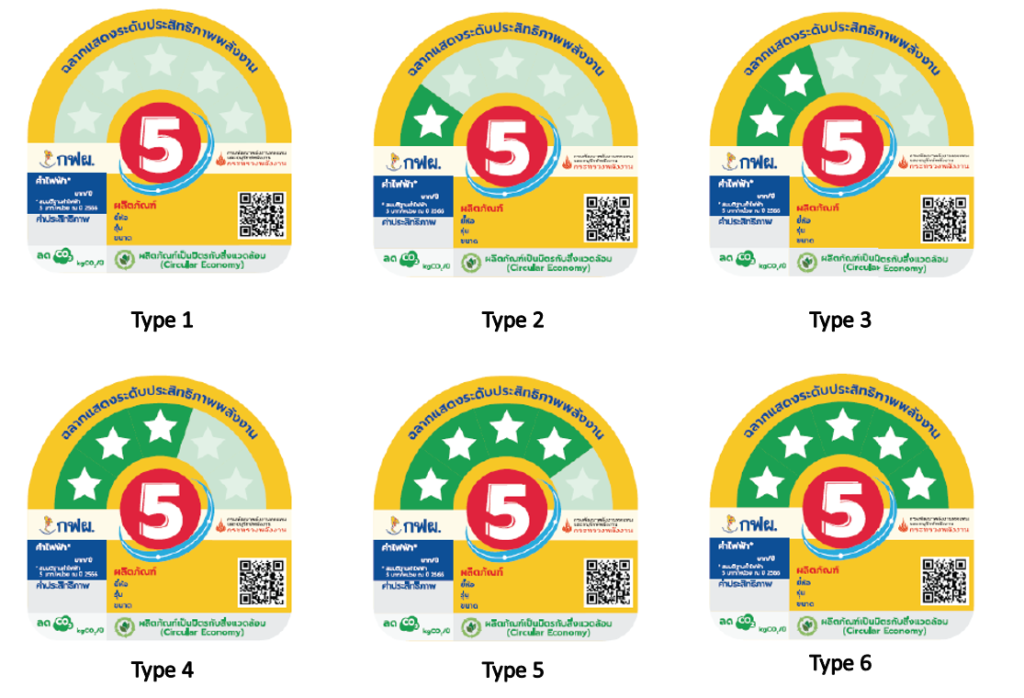
The No. 5 Energy Efficiency Label supports sustainable energy use by encouraging consumers to adopt economical and efficient energy use behavior, reducing unnecessary energy consumption throughout the entire electricity value chain from generation to end user and promoting tangible public participation in greenhouse gas reduction in support of the country’s carbon neutrality goal.
2. Energy Saving Building
EGAT provides consultancy in the promotion of efficient use of energy measure including the selection of construction materials and high- efficiency electrical equipment in the housing and building for residential sector, offices, government, educational institutions, department stores, hotels and hospitals through the following initiatives:
- Energy Consultant Project: Conducted electricity consumption assessments and prepared Measurement & Verification (M&V) reports for 13 sites in 2025, resulting in electricity savings of 5.06 GWh and the reduction of carbon dioxide emission 2,639 tCO2
- No.5 Energy-saving Label for Housing and Building: Collaborated with partner organizations and entrepreneurs from both the public and private sectors, to promote energy-efficient residential and building design based on performance criteria. In 2025, 52 house designs from 26 projects and 11 companies were evaluated, resulting in energy savings of 5.426 GWh and the reduction of carbon dioxide emission 2,829 tCO2
3. Energy Saving Habit
EGAT promotes knowledge, attitudes, and habits related to electricity conservation among educational institutions at all levels, elementary, secondary, and higher education, as well as among the public in business, industrial, and residential sectors. This is achieved through academic services, activities that encourage efficient energy use and environmental preservation, and the provision of materials and equipment. These efforts aim to foster and advance learning toward systematic energy management as follows:
- Energy and Environmental Innovation Competition: Encourages youth to develop skills, potential, and creativity in energy, waste management, and agricultural innovation to reduce energy consumption and carbon dioxide emissions. Award-winning youth teams are granted special quota consideration for further education at 11 universities partnered with EGAT. 347 teams applied, with 30 teams advancing to the final round. Among these, 4 projects demonstrated practical results and real scalability, and 1 innovation has been summited for petty patent registration
- No. 5 Energy-Saving School Program: Promotes low-carbon society development activities in educational institutions and extends results concretely to students’ families. The program supports schools in improving teaching and learning processes as well as energy and environmental management, enabling students to develop knowledge and positive habits in energy conservation and environmental stewardship. In 2025, 132 schools met the criteria to become No.5 Energy-saving Schools, while 96 schools reduced electricity consumption and 25,855 households reduced household electricity consumption. In total, the initiative reduced electricity use by 10.323 GWh and carbon dioxide emissions by 5,384 tCO2
- Smart Green Learning Room: EGAT established Smart Green Learning Room with learning media at four schools to support integrated learning and educational activities on energy and environmental conservation through modern classroom technologies in both online and on-site formats. This is intended to empower youth to become leaders in developing energy and environmental activities, approaches, or innovations, and to extend these benefits to families and communities, thereby contributing to a sustainable Green Learning Society
For monitoring and verification of demand side management performance, EGAT has developed a data collection framework to monitor and verify electricity management performance in alignment with energy conservation measures across residential, business, and industrial sectors. The organization tracks and coordinates data from related projects to support both quantitative and qualitative evaluations. These insights are integrated for post-project analysis to assess cost-effectiveness, with summary reports and recommendations provided. Additionally, EGAT has established and integrated a centralized database and dashboard system to present project progress
In 2025, demands ide management resulted in cumulative energy savings of 8,471.27 GWh and avoided cumulative carbon dioxide emissions throughout the product lifetime, of 4.417 million tCO2
Result of Demand-side Management
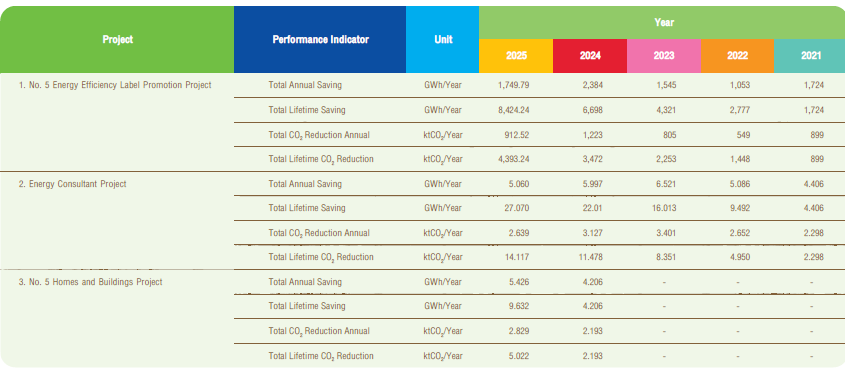
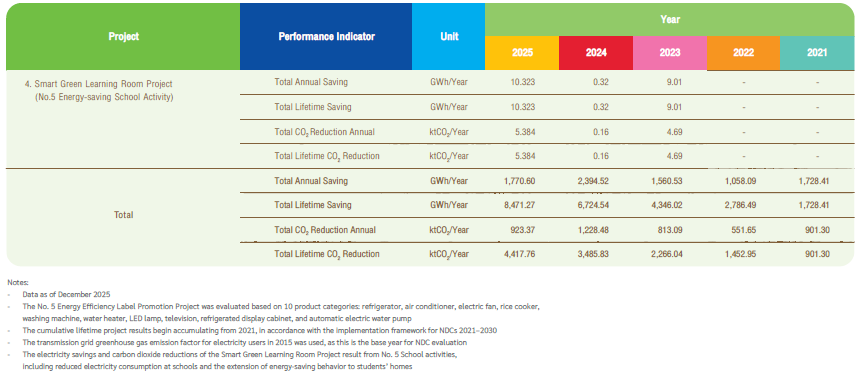
Demand-side Management classified by Target Group
| Project | Residential Sector | Business Sector | Institutional Sector | Industrial Sector |
| No. 5 Energy Efficiency Label Project | • | • | • | • |
| Energy Consultant Project | x | • | • | • |
| No. 5 Homes and Buildings Project | • | x | • | x |
| Smart Green Learning Room Project | • | x | • | x |