Circular Economy
EGAT places importance on the efficient use of resources, the reduction of waste generation, and the avoidance of operations that may adversely affect the environment. The organization has therefore adopted the Circular Economy concept across its operations by planning throughout the entire value chain, from raw material procurement, production, and use to waste management and the reintroduction of materials into the production process for reuse. This approach is aligned with Thailand’s National Strategy B.E. 2561–2580 (2018–2037) and supports the country’s Carbon Neutrality policy by promoting prudent resource use and maximizing resource value.
| 2025 Targets | Performance |
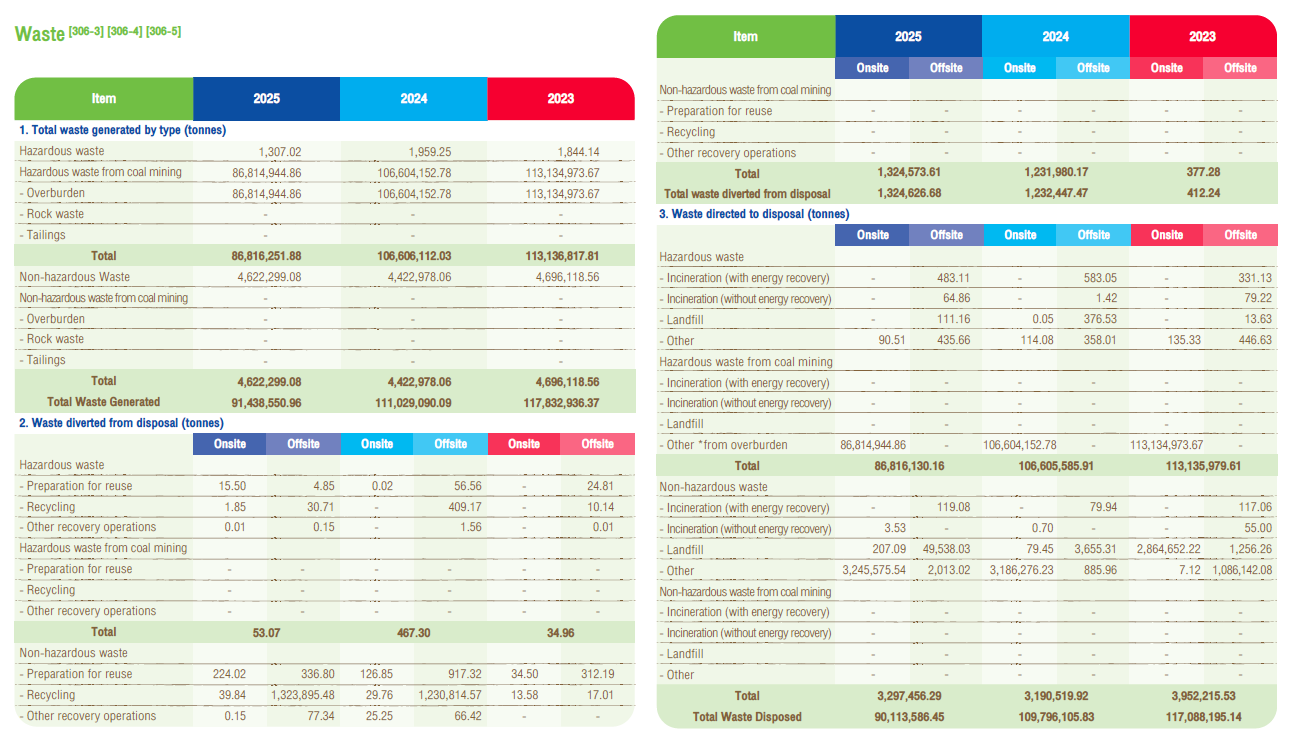
| ● 760,000 tons of waste (fly ash, bottom ash, and gypsum) to be utilized beneficially | ● 1,303,144 tons of waste (fly ash, bottom ash, and gypsum) were utilized beneficially |
| ● Waste management to be compliant with relevant requirements and laws | ● Waste management was carried out in compliance with applicable requirements, laws, and the conditions stipulated in the projects’ EIA/EHIA reports |
Management Approach
EGAT places significant importance on driving the organization toward a circular economy model through the issuance of its Circular Economy Policy, requiring strict compliance by employees and all organizational units. The policy emphasizes efficient resource utilization, waste reduction, and the maximization of waste reuse. EGAT has also developed its Circular Economy Strategic Plan and implementation plan to advance toward becoming the EGAT Circular Economy Organization, with an operational framework covering the period 2021–2030.


In 2025, EGAT successfully achieved the targets under its circular economy project plan related to waste management through three major initiatives:
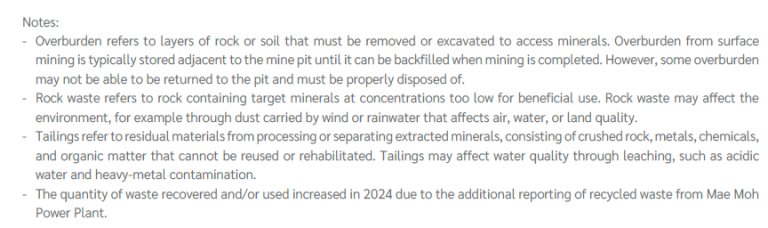
- The utilization of fly ash, bottom ash, and gypsum from coal-fired power plants in the cement and construction industries
- The creation of added value from Leonardite, a by-product of mining, through its use in the agricultural sector
- The management of industrial residues by transforming waste from electricity generation processes into blended fuel for factories or utilizing it through other beneficial methods instead of landfill disposal, in support of the Zero Waste to Landfill target
These initiatives are aligned with EGAT’s circular economy strategic plan, which focuses on transitioning the organization toward a circular economy system and creating value through collaboration with partners.
Key Principles of the Circular Economy
Definition of Circular Economy
Circular economy refers to a concept focused on planning and designing systems to maximize the efficient use of finite natural resources. It emphasizes preserving and creating value within the system by extending the lifespan of materials and products, maintaining a continuous resource circulation loop within a closed system, eliminating waste disposal, and reducing greenhouse gas emissions.
The circular economy system is considered one of the models within the Bio-Circular-Green economic model (BCG), which aims to support sustainable development.
Key Principles of the Circular Economy System

EGAT Circular Economy Implementation
In 2021, EGAT conducted a study to assess the organization’s potential for establishing a circular economy system. This included evaluating EGAT’s environmental performance using the Life Cycle Assessment (LCA) approach. Data was collected from representative areas covering all types of business operations to understand the current practices. EGAT also explored the feasibility of potential pilot projects and developed an EGAT Circular Economy Strategic Plan. These efforts were made to transform EGAT into a circular economy organization, aiming for sustainable development in accordance with the Framework for implementing the principles of the circular economy in organizations – guide (TCAS 2-2562).
In 2022, EGAT announced the Circular Economy Policy to be implemented organization-wide. Pilot projects were initiated across all business units under the EGAT circular economy strategic plan. To support this effort, EGAT established two working groups: one to drive the circular economy system and another to oversee pilot projects. These groups were tasked with advancing implementation in line with strategic objectives and ensuring the achievement of defined targets. Additionally, EGAT developed operational guidelines based on circular economy principles in accordance with the Framework for implementing the principles of the circular economy in organizations – guide (TCAS 2-2562), aiming to become a circular economy organization by 2023.
In 2023, EGAT officially transitioned into a circular economy organization by implementing circular economy policy and operational guidelines across the entire organization. Circular economy pilot projects were actively monitored across all business units to ensure alignment with the policy and strategic objectives outlined in the circular economy strategic plan.
From 2024 onward, EGAT has planned to enhance the implementation of circular economy projects by improving resource efficiency, reducing waste to zero landfill, and elevating operations toward sustainability through innovation.
Implementation According to TCAS 2-2562 Standard
EGAT has integrated the Circular Economy Organization Action Plan into EGAT strategic planning for 2021–2030, with the goal of becoming a circular economy organization by 2023. Based on the evaluation criteria outlined in the Circular Economy Assessment Guidebook by the Department of Primary Industries and Mines (DPIM), EGAT achieved a score of 800 points or higher.
In 2022, EGAT collaborated with the National Science and Technology Development Agency (NSTDA) to collect operational data and assess the effectiveness of circular economy practices across all business units. This data was then used to evaluate EGAT’s overall performance in applying circular economy principles.
In 2023, EGAT, in collaboration with the National Science and Technology Development Agency (NSTDA), conducted an organizational assessment of EGAT circular economy implementation performance. The evaluation followed the criteria outlined in the Circular Economy Assessment Guidebook (2nd revised edition, 2021), issued by the Department of Primary Industries and Mines (DPIM). This framework is based on the Thai Conformity Assessment Standard: Framework for implementing the principles of the circular economy in organizations – guide (TCAS 2-2562), which references the British Standard BS 8001:2017 – Framework for Implementing the Principles of the Circular Economy in Organizations – Guide. EGAT achieved a score of 815 out of 1,000 points. Following the assessment, the 2023 Circular Economy Performance Evaluation Report and the EGAT Circular Economy Organization: Guidebook were developed to support continued implementation.
Since 2024, EGAT has continuously applied circular economy principles and improved organizational operations in accordance with TCAS 2-2562.
Circular Economy Projects
To support the policy and strategic objectives outlined in EGAT circular economy strategic plan, EGAT launched eight pilot projects in 2022, covering all eight business units. Starting from 2024 onward, EGAT plans to further enhance the implementation of circular economy initiatives by improving resource efficiency, reducing waste sent to landfills and incineration, and advancing sustainability through innovation.


Waste Management
The management of waste generated from energy sector operations is a matter of utmost importance to EGAT in order to reduce direct impacts on the environment and all stakeholder. EGAT strictly complies with relevant laws, applicable requirements, the environmental management system (ISO 14001), and circular economy principles, as well as the environmental prevention and mitigation measures and environmental impact monitoring measures related to waste management for each project. Information on waste management is submitted to authorized agencies within the prescribed timeframes. In addition, waste management practices are monitored through internal audits, external certification audits, and management reviews under the environmental management system.
At present, EGAT maintains a waste management database to analyze waste management methods across the organization as a whole and to explore options for reducing waste generated from production processes, as well as for utilizing waste from such processes in place of landfill disposal or incineration. This supports the goal of achieving zero waste to landfill or incineration, in line with National Standardization for Conformity Assessment No. 10-2565: Industrial Waste Management Toward Zero Landfill Requirement.
In addition, EGAT promotes stakeholder participation in waste management in accordance with the organizational application of circular economy principles under the National Standardization for Conformity Assessment No. 2-2562, by collaborating with partner organizations to utilize waste in other industries. One example is the use of end-of-life ceramic heat shields, which serve as high-temperature insulation in power plant combustion chambers, as raw materials in the refractory ceramics industry. EGAT also organizes engagement activities with agencies involved in circular economy systems to support sustainable development through various channels, such as site visits to enhance knowledge and understanding, exchange experiences and perspectives, and foster collaboration among relevant organizations in exploring alternative uses for waste. In addition, EGAT collaborates with academic institutions on research and innovation to develop approaches for utilizing waste as an alternative to landfill disposal.
Waste generated from EGAT’s activities originates from two main sources, namely power plant operations and office-area activities. These are further categorized into hazardous and non-hazardous waste. At present, some waste can be beneficially utilized, while some must still be disposed of through landfill or incineration. EGAT ensures that such waste is transferred only to entities that are properly licensed in accordance with the law, and the disposal methods used by those entities are also verified. As a result, waste sent for disposal is properly managed and causes very low or no impact on surrounding communities and the environment.
Waste Management in Power Plant Areas
EGAT systematically manages industrial waste arising from electricity generation processes, transmission systems, and mining activities, in strict compliance with the environmental prevention and mitigation measures and environmental impact monitoring measures related to waste management for each project.
All hazardous and non-hazardous waste generated is collected and classified according to its type, characteristics, and quantity. The waste is stored in secure and durable containers or packaging, with clearly designated storage areas to prevent chemical reactions that may pose hazards, as well as spills and leaks. Control systems are also in place to prevent waste from contaminating or spreading into the surrounding environment.
EGAT considers management methods for all types of waste in order to maximize beneficial use, as follows:
- Waste that can be beneficially utilized is reused or recycled internally within the organization. Waste with the potential to serve as raw material in external industries is managed in collaboration with partner organizations.
- Waste that cannot be reused is transferred to disposal contractors licensed by the Department of Industrial Works, with the quantity and management method reported every six months in reports on compliance with environmental prevention, mitigation, and monitoring measures submitted to the relevant permitting authorities.
Waste Management in Office Areas
EGAT manages waste generated from office-area activities, including activities arising from office operations, medical facilities, and vehicle fleet units, through the following measures:
- Developing online training courses and waste separation manuals to provide employees with knowledge and understanding of proper waste management practices
- Promoting waste separation at source in order to reduce the amount of waste requiring management and to support the highest possible levels of reuse and recycling, with waste collection containers clearly labeled by waste type. Waste is classified into five categories: general waste, biodegradable waste, recyclable waste, hazardous waste, and orphan waste or energy waste
- Establishing waste collection points covering both indoor and outdoor office areas for the temporary storage of waste awaiting transfer to authorized disposal entities, without causing visual pollution or other forms of environmental contamination
In 2025, EGAT collaborated with external organizations to promote beneficial waste utilization. EGAT also served as an intermediary by establishing collection points for municipal solid waste from surrounding communities and transferring the collected waste to organizations that could further utilize it. These efforts were carried out through the Won Project (flexible plastics), the Cirplas Project (rigid plastics), the Thailand Post ReBox Project (cardboard), and the Wake Up Waste Project (recyclable waste).
To monitor municipal solid waste disposal, EGAT requires external contractors responsible for waste disposal to submit documentary evidence, such as receipts or other supporting documents, demonstrating that the waste has been properly disposed of. EGAT also conducts random inspections of contractors’ disposal facilities to ensure that operations are carried out properly, transparently, and without adverse environmental impacts.

In 2025, no incidents of waste leakage resulting in significant impacts on the environment or surrounding communities were identified from EGAT’s operations. In the event of an emergency involving the leakage of waste, EGAT has preventive and mitigation measures, environmental restoration plans, and remedial measures for affected persons in place, with regular drills conducted accordingly. EGAT also maintains close coordination with relevant government and local authorities to ensure that such situations can be managed effectively.