Human Resource Management and Development
EGAT places great importance on human resource care and the creation of a positive working environment. The organization provides opportunities for employees to develop their knowledge and capabilities and to grow professionally, while fostering a workplace where diversity can collaborate effectively. This supports driving the organization forward and delivering sustainable value to stakeholders.
| Target for 2025 | Performance |
| ● Employee engagement score of not less than 80% | ● Employee engagement score: 85% |
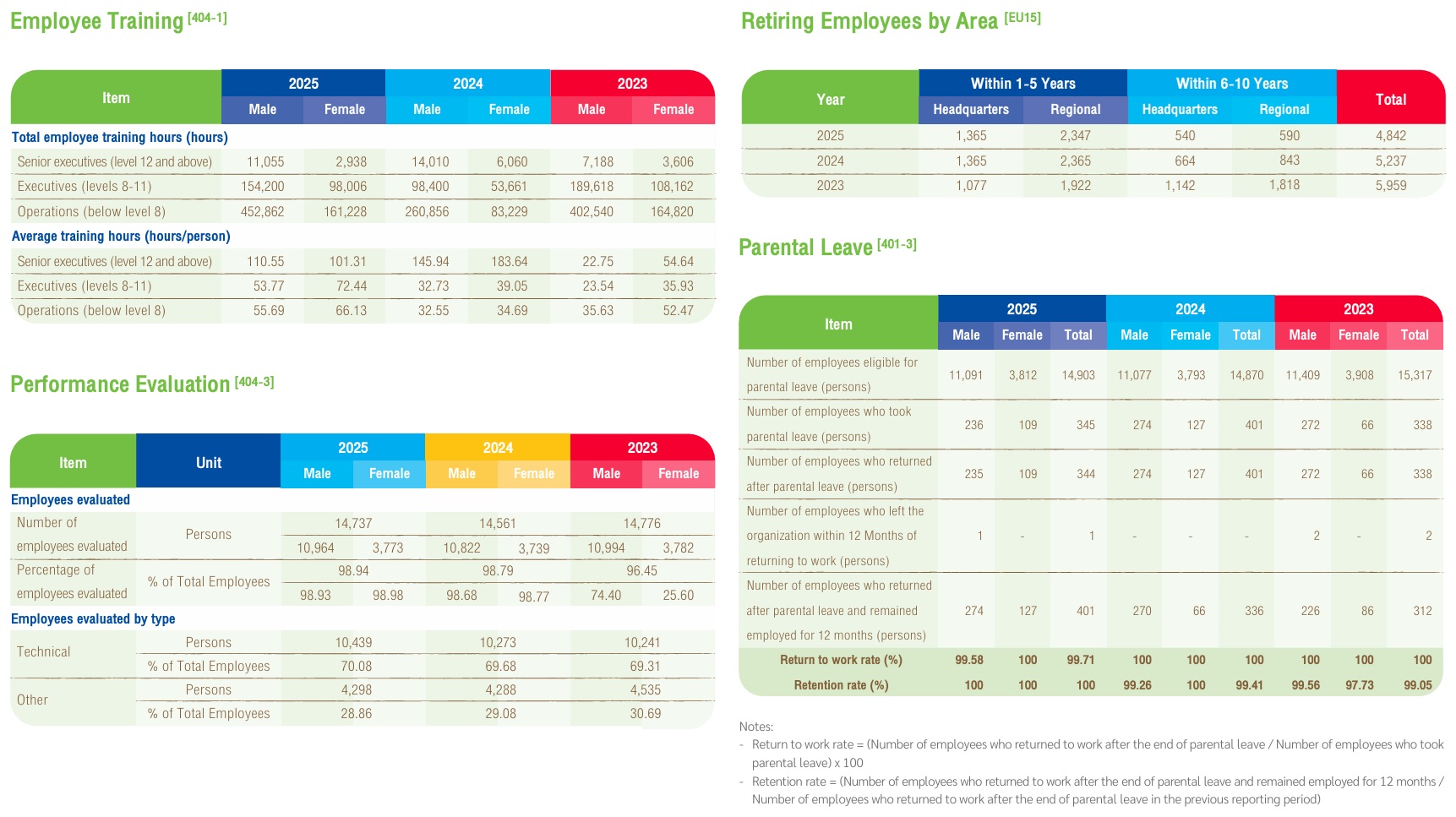
| ● Average training hours per employee: – Management level: not less than 49.84 hours per person – Operational level: not less than 30.55 hours per person | ● Average training hours: – Management level: 61.19 hours per person – Operational level: 58.01 hours per person |
Policy and Commitment
EGAT recognizes its personnel as a vital and highly valuable resource for sustainable organizational growth. Therefore, the organization has established a comprehensive human resource policy as a common guideline across all units. This commitment to continuous HR development has resulted in EGAT receiving three awards at the HR Asia Awards 2025, namely:
- HR Asia Best Companies to Work for in Asia 2025, reflecting its status as one of the best workplaces in Asia
- HR Asia Tech Empowerment Awards, recognizing excellence in leveraging technology to drive the organization
- HR Asia Sustainable Workplace Awards, demonstrating outstanding performance in creating a sustainable workplace that cares for both employees and the environment
Operational Structure
The EGAT Board of Directors appoints the Human Resource Committee to establish HR management and development policies, approve master plans and annual action plans, and oversee HR operations while providing recommendations to management. The Human Resource and Organization Development Division and the Human Resource Development and Quality Division are responsible for HR management and development, respectively.
Management Approach
In 2024, EGAT reviewed and proposed updates to its human resource policies, introducing two key enhancements:
Human Resource Management
EGAT has established human resource management practices in accordance with its personnel management manual, which covers employee care throughout the entire employee lifecycle, from onboarding to retirement. In addition, EGAT has developed a Human Resource Master Plan and corresponding action plans for the period 2025–2029, comprising a total of eight plans, as follows:
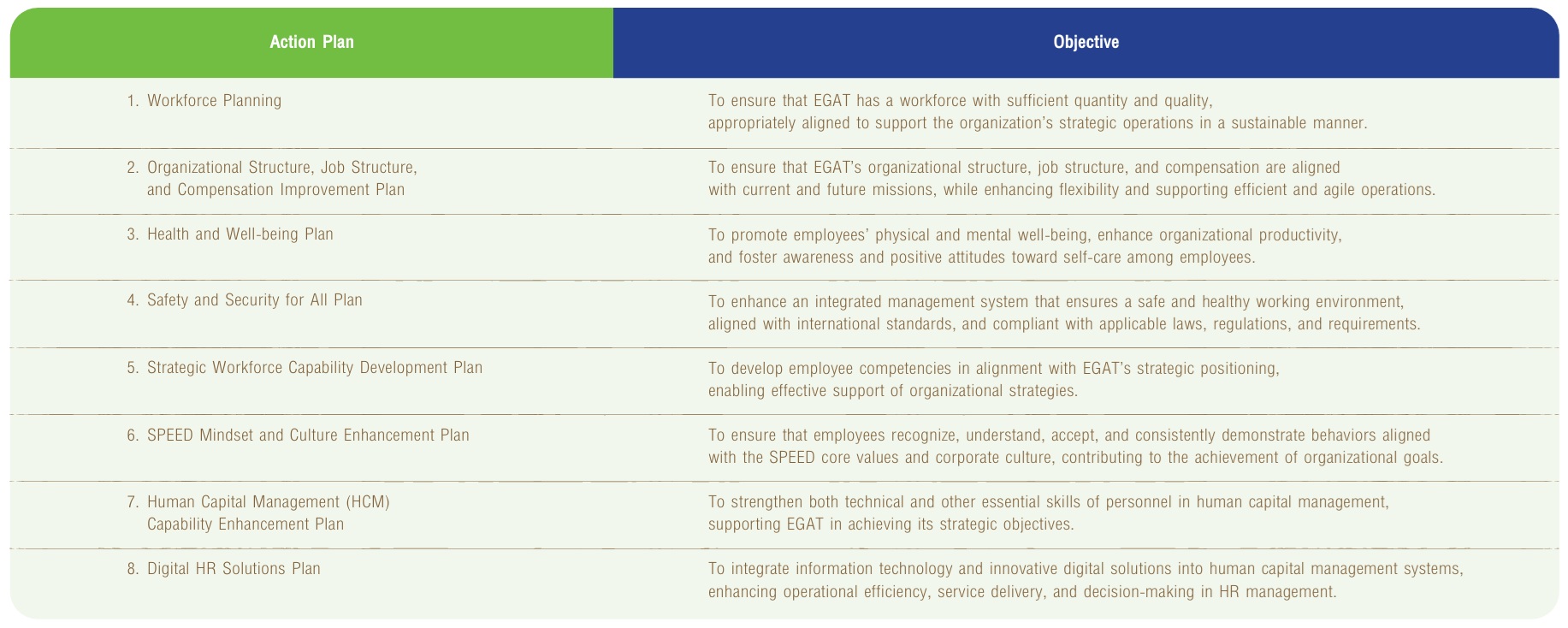
For monitoring and evaluation, EGAT requires quarterly reporting of performance results under the Human Resource Master Plan action plans to the EGAT Executive Committee for acknowledgment and to seek feedback or recommendations. In addition, the Plan-PA-Risk Management (PPRM) system is utilized to monitor action plans on a monthly basis. Annual surveys on employee engagement, well-being, and employee experience are also conducted. Furthermore, Human Capital Management (HCM) is assessed by the State Enterprise Policy Office.
In 2025, EGAT successfully implemented the action plans under the Human Resource Master Plan and achieved 100% of the targeted outcomes. However, EGAT remains committed to continuous improvement, with key enhancement approaches including:
- Improving operational procedures of the annual action plans under the Human Resource Master Plan (2025–2029) to ensure greater clarity for implementation and measurable outcomes, as well as alignment with HR strategic positioning. This includes the development of HR management approaches to support the organization’s transition in the energy context during 2025–2027, and the enhancement of human capital management for a sustainable clean energy future during 2028–2029.
- Adding a review process for the development of employee compensation and benefits by incorporating feedback and needs identified from employee surveys into the design of compensation development approaches.
- Developing and enhancing the Individual Development Plan (“My Plan”) to strengthen employee capability, by linking My Plan with performance and competency evaluation results under the Performance and Competency-based Management System Program (PMSP).
- Expanding the analysis of employee experience into three phases: Pre-employment, Employment, and Post-employment, based on employee experience journey touchpoints. This also includes studying best practices from research, trends, and industry benchmarks, as well as organizations recognized for excellent employee experience both domestically and internationally.
In addition, EGAT conducts human resource operations in collaboration with both internal and external stakeholders as follows:
- Communicating and clarifying HR operations to stakeholders through various channels, including meetings between employer and employee representatives, labor relations committee meetings, EGAT executive meetings, forums and showcase exhibitions under the Deputy Governor – Administration, public relations releases, and official EGAT social media.
- Communicating the Human Resource Master Plan to relevant parties and publicizing HR policies and regulations that have been revised and impact employees, such as promotion criteria and welfare reimbursement policies, through appropriate communication channels. These include live broadcasts, internal communication platforms, management communication, and dissemination via email and internal social media. In cases of significant changes that may affect employees, EGAT does not specify a minimum advance notice period. Generally, EGAT does not modify employment conditions in ways that are disadvantageous to employees. For improvements that are beneficial to employees, communication is provided after implementation, as such changes do not result in negative impacts that require advance preparation. For changes arising from managerial prerogative, communication or public relations will be conducted as appropriate on a case-by-case basis.
- Communicating HR-related information to external stakeholders in a systematic, clear, and transparent manner. For example, in external recruitment, EGAT communicates upcoming job openings in advance to allow interested applicants time to prepare. Job announcements are clearly publicized through multiple channels, with open and equitable qualification criteria. Information technology systems are utilized to facilitate application tracking, examination schedules, and results, ensuring accurate, comprehensive, and efficient communication with applicants.
- Providing opportunities for stakeholders to participate in human resource management through feedback and complaint channels. EGAT also conducts an annual survey on employee acceptance of the Human Resource Management (HRM) system across the entire organization. The results are used to improve HR management processes and serve as input for the development of the Human Resource Master Plan in the following year. Additionally, satisfaction surveys are conducted among employees who utilize HR services at service points to assess service efficiency and support continuous improvement.
Compensation
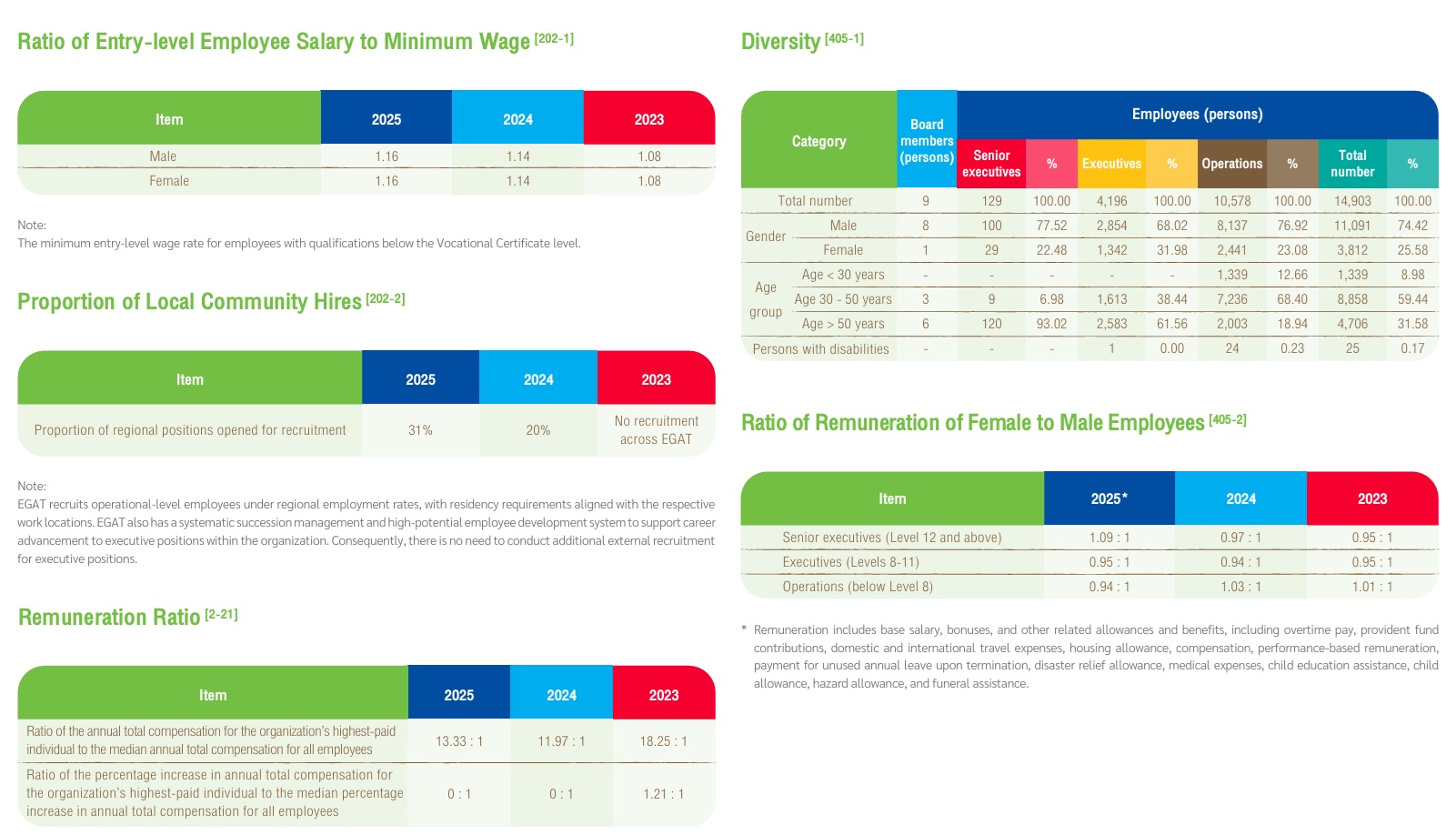
EGAT places importance on establishing compensation at an appropriate level that is sufficient to support employees’ cost of living. In determining compensation, EGAT takes into consideration its human resource policies, management policies, employee demands through the labor union and the EGAT Labor Relations Committee, employee engagement survey results, as well as changes in laws and government policies. In addition, compensation benchmarks in the labor market, which are regularly surveyed in collaboration with external organizations on an annual basis, are analyzed to develop compensation proposals for submission to the EGAT Executive Committee and the EGAT Board of Directors in cases related to existing financial employment conditions. For matters beyond these, approval must be sought from the State Enterprise Labor Relations Committee and the Cabinet.
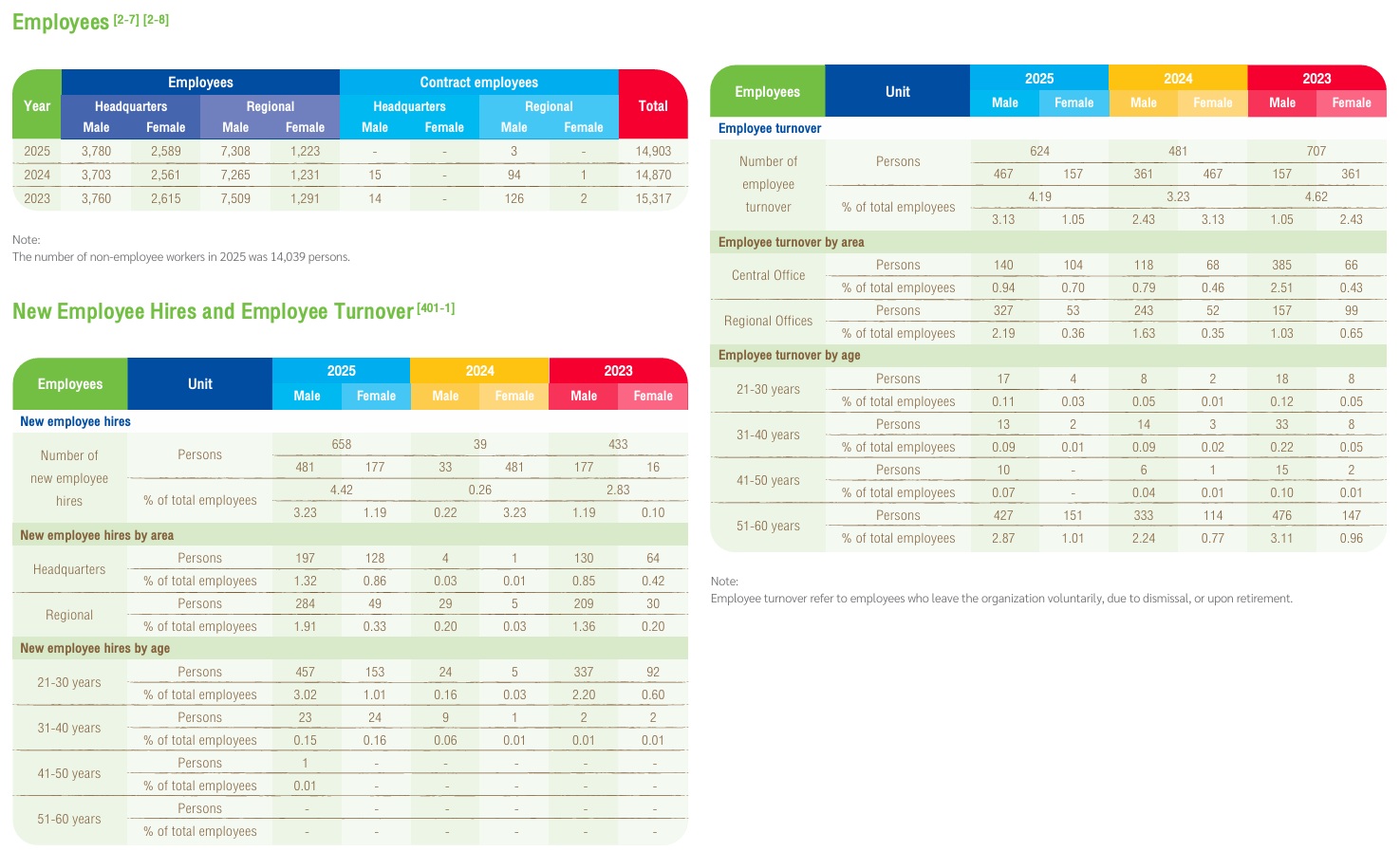
In 2025, the results of the satisfaction survey on compensation and benefits indicated that employees reported a high level of satisfaction, accounting for 78.66%. Furthermore, EGAT ensures equal compensation for male and female employees without discrimination.
EGAT employees have normal working hours of 7 hours per day, not exceeding 48 hours per week. Employees are required to record their working hours accurately through the EGAT Time Attendance System (ETAS), which is an efficient system for recording and monitoring working hours. In cases of necessity, urgency, or where the nature of work requires continuity and failure to perform would result in organizational damage, supervisors may approve overtime work. Employees are compensated for overtime on an hourly basis.
Welfare and Benefits
To promote a high quality of life for employees, EGAT regularly reviews and improves employee welfare and benefits to ensure their appropriateness. This also includes the provision of welfare and benefits to outsourced personnel, with requirements clearly stipulated in the terms of reference and service contracts, obligating contractors to strictly comply with labor protection laws and the Social Security Act.
| Welfare and Benefits | Senior Executives | Executives | Operational Level / Special Contract Employees |
| Per diem / accommodation allowance for domestic business travel | ● | ● | ● |
| Per diem / accommodation allowance for international business travel | ● | ● | ● |
| Loans (e.g. emergency loans, education loans for children) | ● | ● | ● |
| Housing allowance | ● | ● | ● |
| Provident fund | ● | ● | ● |
| Medical allowance and treatment at EGAT medical facilities (*) | ● | ● | ● |
| Overtime pay and holiday pay | ● | ● | ● |
| Uniforms | x | x | ● |
| Compensation or recognition for high-risk job (**) | ● | ● | ● |
| Special allowances for specific duties or tasks (e.g. underwater operations, welding skills) (**) | x | ● | ● |
| Hazard allowance and accident insurance for employees in southern border provinces (***) | ● | ● | ● |
| Special compensation or leave for employees in southern border provinces (***) | ● | ● | ● |
| Hybrid Working arrangements (**) | ● | ● | ● |
| Leave entitlements (e.g. annual leave, sick leave, maternity leave, parental leave) | ● | ● | ● |
Notes (*) Includes employee’s family (**) Applicable to specific duties or tasks (***) Applicable to high-risk areas
EGAT places importance on employees’ leave entitlements, particularly annual leave, to support physical and mental recovery or other personal purposes. Employees can conveniently access information on their entitled, used, and remaining leave days, as well as submit leave requests through the Electronic Document Management System (EDMS). In addition, unused leave days can be accumulated and carried forward to subsequent years, within the prescribed limits.
Freedom of Association and Collective Bargaining
EGAT supports employees’ freedom to establish and join associations and to engage in collective bargaining within the framework of applicable laws and the organization’s internal regulations. This includes participation in the State Enterprise Workers’ Union of EGAT (EGAT Labor Union), the EGAT Labor Relations Committee, internal coordination working groups, and employee negotiation representative committees concerning employment conditions.
Such associations and negotiation platforms serve as important channels for communication between management and employees, fostering mutual understanding in cases of issues or disputes and strengthening sound labor relations. Regular monthly meetings are held between employer representatives, who are EGAT executives, and employee representatives, who are members of the EGAT Labor Union, through the EGAT Labor Relations Committee to discuss improvements in employment conditions and to resolve labor-related disputes within the organization.
Regarding labor negotiations, by law, employees who are entitled to benefits under employment agreements between EGAT and the EGAT Labor Union are those who are union members. In 2025, there were 8,987 union members, representing 60.26% of the total workforce. However, EGAT extends the benefits under such agreements to all employees, representing 100% coverage. EGAT also applies improvements in employment conditions arising from such agreements equally to non-union employees to ensure consistency and orderly management of compensation, welfare, and benefits.
Performance Evaluation
Employee performance evaluations are conducted in accordance with established criteria, comprising 30% individual behavioral indicators and 70% performance assessments based on agreed work objectives between supervisors and employees. The evaluation results are used to inform decisions regarding compensation, appointments, and personnel development. Performance evaluations are conducted for all employees.
Human Resource Development
To ensure that EGAT personnel are well-prepared to effectively respond to the evolving direction of the energy industry, EGAT places great importance on developing the capabilities and skills of employees at all levels. This includes conducting needs assessments aligned with the Human Resource Master Plan and key initiatives supporting the organization’s strategy, as well as evaluating required skills such as core technical competencies. Based on these assessments, EGAT establishes development frameworks to address competency requirements, including both short-term urgent development and long-term development plans tailored to levels, positions, and career paths. This also encompasses the development of successors and high-potential employees, as well as the development of new skills to support future missions. Appropriate objectives, formats, and methods of development are determined as follows:
1. Development for Executives and General Employees
- Level-based development (Levels 1–14, including special contract employees):
Programs are designed specifically for EGAT personnel, focusing on competencies required for each level and position. The content covers organizational values (SPEED), behavioral KPIs, managerial competencies for supervisory roles, and key urgent issues. Development programs are aligned with organizational strategy and anticipate future competency requirements to ensure readiness for change, while also considering learning behaviors across different employee levels through diverse development methods. - Career path development:
Focuses particularly on addressing gaps in core technical competencies which serve as the fundamental basis for development for both executives and employees, aligned with expected competency levels.
2. Development for Successors and Talents
A two-year Development Roadmap is established to develop and prepare executives and employees for succession in leadership roles and appointment to key positions within EGAT. This is implemented through various development approaches, including the Individual Development Plan (IDP).
3. Professional Competency Development Aligned with Occupational Standards
EGAT collaborates with the Thailand Professional Qualification Institute (Public Organization) to develop occupational standards in energy, renewable energy, and electric vehicles. The EGAT Professional Certification Center has been established to assess and certify professional competencies in six fields which are (1) Power generation systems, (2) Hydropower generation, (3) Transmission systems, (4) Solar power systems, (5) Wind power systems, and (6) Electric vehicles.
This initiative aims to enhance workforce capabilities and expand career opportunities, supporting Thailand’s energy transition.
4. Future Skills Development
EGAT conducts analysis and planning to develop new skills aligned with future strategic missions, such as renewable energy, energy storage systems, and flexible power grid integration to support future power systems. The organization also focuses on developing skills that contribute to national carbon neutrality goals. Development approaches are diversified and continuously monitored to ensure effectiveness.
5. New Employee Orientation Program
Orientation programs are provided to prepare new employees and build their understanding of EGAT’s core mission essential for their roles. Additionally, targeted development is provided for new employees in specific functions, particularly in renewable energy, digital, and business units, to equip them with specialized knowledge relevant to their responsibilities.
In addition, EGAT organizes annual retirement preparation programs for retiring employees, focusing on knowledge related to post-retirement benefits and welfare, physical and mental health care, and financial planning to ensure a smooth transition into retirement.
DEI&B at EGAT
EGAT places importance on diversity, equity, inclusion and belonging (DEI&B). In addition to aligning with the concept of “EGAT for All”, an organization that is open to and serves everyone. DEI&B is also a key element of the SPEED values and corporate culture, encouraging employees to adopt these principles in practice and reflect them in all aspects of operations, as follows:
Diversity
In a world of diversity, respecting and embracing differences is essential. This not only creates a positive working environment but also fosters creativity and innovation within the organization.
- Recruitment: EGAT implements recruitment policies and processes that comply with laws, are non-discriminatory, and are open to candidates from diverse backgrounds, such as gender, religion, and education.
- Dress: Employees may dress appropriately for the occasion, the nature of their work, and applicable safety requirements, without gender-based discrimination
- Working Across Differences: EGAT integrates a diverse workforce comprising 4 generations, 6 levels of education, 30 job types, and 388 work locations, with more than 14,000 employees. Cross-functional collaboration is encouraged in new business areas such as energy solutions and electric vehicle solutions, where teams with diverse skill sets work together toward common goals. In addition, employee groups are supported to foster understanding of diversity, including clubs representing different beliefs and religions, senior employee clubs, sports clubs, and social contribution clubs, with the aim of strengthening positive relationships among employees.
Equity
Fair and unbiased treatment of employees, without prejudice against differences, while providing appropriate tools and resources based on individual roles and responsibilities.
- Human Rights: EGAT reviews and assesses its human rights performance in accordance with ISO 26000, including Human Rights Due Diligence (HRDD).
- Equal Access to Benefits: Welfare and benefits are provided comprehensively and equitably, including provident funds, medical benefits, and education support for employees’ children.
- Opportunities for Development: Online learning systems are provided to allow employees to pursue self-directed learning based on their interests, ensuring equitable access to skill development opportunities.
- Leadership Diversity: Leadership appointments are based on capability, knowledge, and job requirements, with equal opportunities for all genders.
- Grievance Channels: EGAT emphasizes listening to stakeholder feedback through multiple complaint channels, managed in accordance with good corporate governance principles.
Inclusion
Creating an environment where everyone feels valued, safe, and able to participate and express themselves equally is fundamental to engagement. When individuals feel recognized and accepted, it fosters innovation and creativity, strengthens corporate culture, and supports long-term growth.
- Employee Engagement Activities: Activities such as sports and recreational programs are organized to strengthen internal relationships.
- Volunteer Activities: Employees are encouraged to participate in social and environmental initiatives.
- Innovation Promotion: Employees are supported in contributing ideas and innovations through competitions and creative projects.
- Feedback Mechanisms: Multiple internal communication channels are provided for employees to express opinions conveniently, promoting transparency and mutual understanding. In addition, 360-degree behavioral evaluations enable employees to receive feedback from peers, supervisors, and subordinates, supporting personal development and strong team relationships.
Belonging
Belonging emphasizes being part of a team or organization. It is the result of diversity, equity, and inclusion, fostering a sense of acceptance and value. This strengthens collaboration and a positive working environment, enabling the organization to achieve its goals effectively.
Key initiatives undertaken by EGAT to promote DEI&B in 2025 included the following:
Policy Enhancement
Integration of DEI&B principles into EGAT’s Human Resource Policy, emphasizing respect for diversity and equality without discrimination based on gender, race, religion, age, social status, or educational background, and implementation across the organization.
“Know Me Again” Campaign
A DEI&B promotion initiative communicated through one-minute video clips featuring over 30 EGAT employees, addressing the question “What do people misunderstand about us?” to reduce bias and enhance mutual understanding of diversity.

SPEED Talks 2025: “Connecting Diversity and Value for a Sustainable Future”
A forum designed to build knowledge, understanding, and inspiration for developing capabilities and behaviors aligned with organizational values and culture, focusing on mindset development for sustainability, promoting DEI&B, and creating shared value with society.
SPEED Cheer Up Platform
An online platform that enables employees to send appreciation messages recognizing behaviors aligned with SPEED values and corporate culture, promoting respect, recognition, and a positive working environment.