
Risk Management and Business Continuity
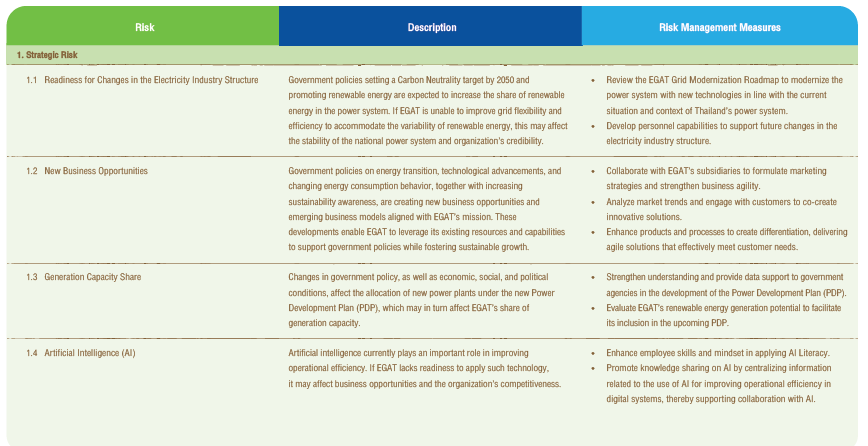
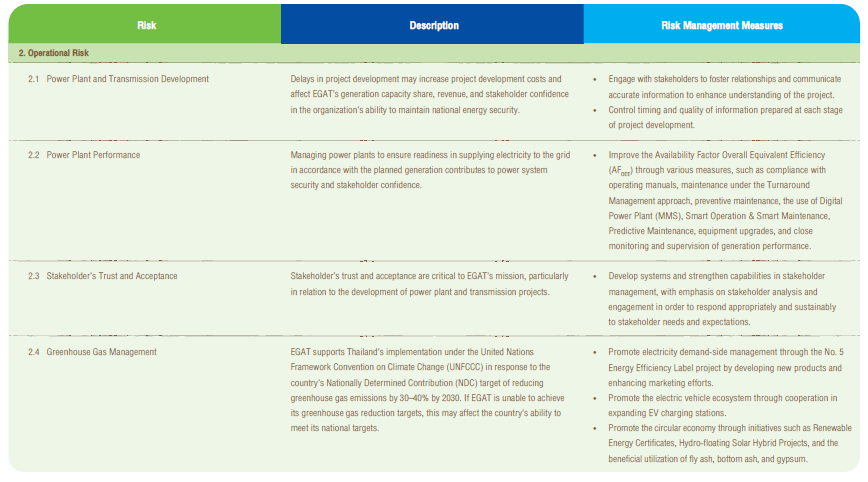
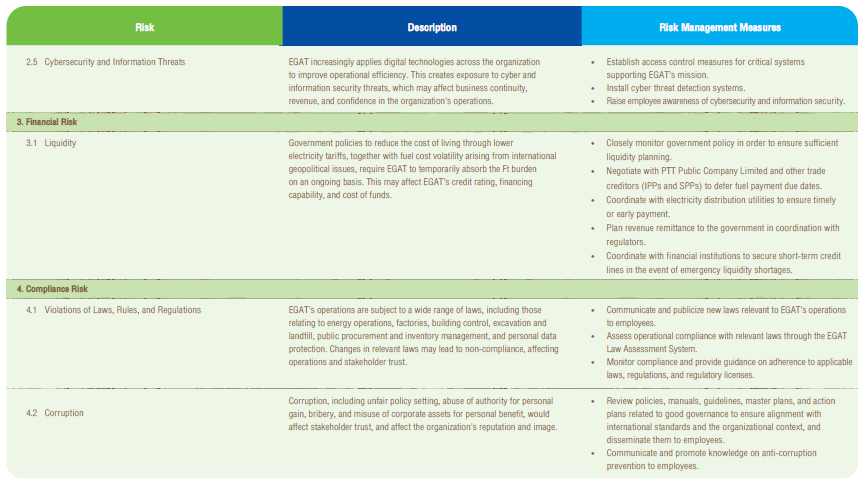
Risk management and business continuity are critical processes for ensuring that EGAT is able to continue its electricity business operations without interruption, respond rapidly to crises or emergencies, and prevent and mitigate the impacts of risks that may affect the achievement of the organization’s mission.
| Targets for 2025 | Performance |
| ● Achieve 100% alignment between enterprise risk management and sustainability factors (ESG). | ● Alignment between enterprise risk management and sustainability factors (ESG) reached 100%. |
| ● Conduct an internal audit of EGAT’s Business Continuity Management System in accordance with ISO 22301. | ● An internal audit of EGAT’s Business Continuity Management System was conducted in accordance with ISO 22301. |
| ● Ensure that 100% of business continuity plan exercises and emergency response plan drills cover all critical processes in line with EGAT’s business continuity context. | ● The proportion of business continuity plan exercises and emergency response plan drills covering all critical processes in line with EGAT’s business continuity context reached 100%. |
Risk Management
Policy and Commitment
To ensure effective organizational risk management, EGAT has established a risk management and internal control policy, along with implementation guidelines on good governance, risk management, and compliance (GRC). The risk management structure includes the EGAT Board of Directors, the Risk Management and Internal Control Committee, the EGAT Executive Committee, risk management committees at operational line level, the Audit Committee under the Office of Internal Audit, and all EGAT personnel. The Risk Management and Internal Control Department, under the Strategic Planning Division, supports enterprise-wide risk management by formulating policies, setting acceptable risk levels, developing risk management guidelines, and preparing an annual risk management manual and review.
Operational Structure
As risk management involves personnel at all levels, clearly defining reporting lines, roles, duties, and responsibilities helps all functions perform their assigned duties effectively and serves as an important mechanism for ensuring the timely identification, assessment, management, and monitoring of risks. EGAT has therefore established the following structure for risk management, internal control, and GRC:
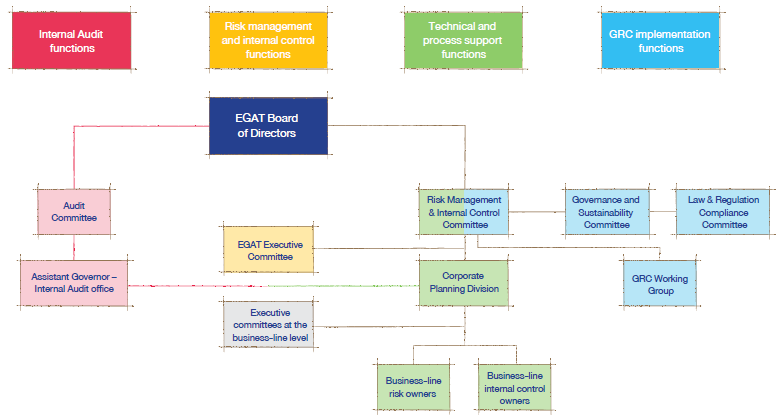
- Risk management and internal control functions include the EGAT Board of Directors, the EGAT Executive committee, executive committees at the business-line level, and all executives and employees across EGAT. They are responsible for managing operational risks within their respective areas of responsibility so that business-line and unit objectives can be achieved.
- Technical and process support functions include the Risk Management & Internal Control Committee (comprising EGAT Board of Directors, qualified experts who are not EGAT executives, and EGAT executives), Corporate Planning Division (Risk Management and Internal Control Department), and business-line risk owners. These parties are responsible for establishing policies, frameworks, and manuals for risk management as operational guidelines, and for supporting the collection, monitoring, and review of risks at the enterprise level, as well as promoting awareness and understanding of risk management to enable effective implementation.
- Internal Audit functions include the Audit Committee and the Internal Audit Office, which conduct annual independent reviews to ensure that the organization’s risk management system is sufficiently effective and efficient, and provide recommendations for improvement.
- GRC implementation functions include the Governance and Sustainability Committee, the Risk Management & Internal Control Committee, and the Compliance with Law & Regulation Compliance Committee, which oversee and monitor EGAT’s implementation to ensure practical alignment and integration of the relevant areas. A GRC Working Team supports implementation in accordance with the GRC policy.
Management Approach
EGAT manages risk in a systematic, continuous, and organization-wide standardized manner, in accordance with the framework of The Committee of Sponsoring Organizations of the Treadway Commission – COSO Enterprise Risk Management: Integrating with Strategy and Performance 2017 (COSO 2017) and the risk management and internal control criteria of the State Enterprise Policy Office, Ministry of Finance, in order to ensure that risk management and internal control are effective and efficient and aligned with the organization’s goals and strategy.
EGAT seeks to build an organizational culture of risk management by making risk management an integral part of operations. All employees are required to take risks into consideration and use risk information in decision-making and operations at every stage. EGAT also enhances knowledge and understanding of risk management. For example, the EGAT Board of Directors received training on ESG Risk Management & Energy Transition, executives received training on GRC and Enterprise Risk Management: Sustainability and Growth, and two online training courses, namely Risk Management & Internal Control and Governance, Risk and Compliance (GRC) were prepared for employees across the organization.
Risk Identification
EGAT analyzes risks that may affect operations by considering both internal factors such as strategy, goals, and key performance indicators, and external factors such as the electricity industry context, government policies affecting EGAT, and the needs and expectations of stakeholders in a comprehensive manner.
The identified risk issues are then used to assess the effectiveness of existing controls in order to determine residual risk. Risks for which controls are found to be insufficient are identified as risk factors for further management.
Risk Assessment
Risks are assessed by considering two factors: Probability and Impact. The results are then used to prioritize risks according to their severity, which is determined as the product of the probability and impact levels.
Subsequently, the organization establishes its risk appetite and defines risk tolerance ranges that do not adversely affect its strategic objectives and business goals. Long-term and annual targets are also set to provide a structured framework for effective risk management.
Risk Response
EGAT determines its risk response strategies based on four key approaches: risk acceptance, risk reduction, risk sharing, and risk avoidance. These approaches are selected by considering the costs and benefits of each option so that resources allocated for risk response are used efficiently. EGAT then develops risk management plans or measures and monitors implementation through the Plan-PA-Risk Management (PPRM) system, which integrates strategic planning, performance evaluation, and risk management at the enterprise, business-line, and division levels.
The results can also be displayed in the Enterprise Performance Management (EPM) system, which is used by the EGAT Board of Directors, the Executive Committee, and senior executives to monitor performance. In addition, EGAT operates an Early Warning System (EWS) to provide advance alerts for key performance indicators that may deviate from projections or targets. Alerts are sent to executives and relevant personnel so that corrective action can be taken in a timely manner.
Business Continuity Management
Policy and Commitment
EGAT has established a Business Continuity Management policy to ensure the organization’s preparedness to maintain the generation, procurement, and delivery of electricity continuously and efficiently during crisis situations.
Operational Structure
Security and Safety Division is responsible for overseeing the development of standards, providing recommendations, and offering technical support on risk engineering and business continuity management, as well as overseeing and supporting crisis management and business continuity management so that EGAT can continue operations efficiently and effectively.
In addition, EGAT has established the EGAT Business Continuity Management Committee, chaired by the Assistant Governor – System Control, with division-level representatives from all business lines serving as members. The committee is responsible for setting the framework, policies, manuals, and guidelines for business continuity management; developing and updating EGAT’s business continuity management system in line with international standards; reviewing critical processes; conducting business impact analysis; assessing risks from threats that may affect EGAT’s business; and defining business continuity strategies, including the integration of drills, crisis management, and crisis communication.
Management Approach
EGAT has established a business continuity management system aligned with ISO 22301:2019, with key actions as follows:
- Studying and understanding the organizational context, and assessing risks in accordance with the business continuity management system approach. The risk issues considered are aligned with enterprise-wide risk management.
- Establishing business continuity strategies aimed at reducing the likelihood of disruption, shortening the duration of disruption, and limiting the impacts of disruption, through the preparation of business continuity plans (such as a widespread power outage business continuity plan and a cyber threat business continuity plan) and emergency response plans (such as fire, earthquake, flood, sabotage, and substation equipment failure response plans).
- Conducting emergency response drills and business continuity exercises at the unit, functional and organizational levels, as well as joint exercises with external organizations, to ensure readiness for possible incidents and the ability to manage them rapidly and effectively. Simulated scenarios are based on potential risks such as power plant fires, widespread power outages, and natural gas pipeline fuel supply interruptions. Training is continuously provided to employees.
- Conducting annual internal audits to ensure continuous improvement and development of EGAT’s business continuity management.
- Communicating and disseminating information on business continuity management to stakeholders, including PEA, MEA, and direct customers through seminars and annual briefings, and assessing awareness of such communications, with feedback used to improve implementation plans.
Significant Events in 2025
Landslide at the Overburden Disposal Area of Mae Moh Mine, Lampang Province
Incident : On 4 November 2025, mass soil movement and a landslide occurred at the southern section of the western overburden disposal area of Mae Moh Mine, in an area where EGAT is authorized to conduct mining activities and deposit soil and overburden materials. The preliminary damaged area covered 6.3 square kilometers. The incident is believed to have been caused by continuous heavy rainfall in the area since 31 October 2025.
Impact : The soil conveyor systems under Contracts 8 and 9, the Contract 8 site office, the main drainage canal of the Mae Moh Mine over a distance of 2.5 kilometers, the mine dewatering system, nine high-voltage transmission poles, and the coal working area within the mine were damaged. However, there were no injuries or fatalities. The incident did not affect surrounding communities or disrupt electricity supply in the northern region.
Response : EGAT urgently managed the situation with primary emphasis on energy security and maximum safety, through the following actions:
- Established a war room to monitor the situation, conducted on-site damage inspections, and issued an order closing the area and suspending certain mining activities
- Issued continuous public statements to the media and held briefings with communities and relevant government agencies
- Installed 31 real-time land movement monitoring devices (RTK-LandMos) to monitor further soil movement, as well as groundwater pressure monitoring instruments and drilled underground drainage holes
- Installed pumps at the main diversion canal area that had been blocked by the landslide in order to drain water
- Prepared a soil overburden stockpile management plan for submission to the Lampang Provincial Industry Office and the Regional Office of Primary Industries and Mines Region 3, Chiang Mai for consideration prior to implementation
- Accelerated restoration of the damaged soil conveyor systems for return to operation within 6 months
- Regraded the landslide area to prevent ignition and water seepage through cracks, and developed a surface drainage system covering 4.75 million square meters
- Managed drainage of the main diversion canal and lowered water levels at Mae Kham Dam to accommodate rainfall
- Implemented flood prevention measures for nearby communities by constructing earthen embankments and installing a pumping system from Hua Fai Community to the main diversion canal
- Monitored water quality twice a week; current water quality remains within standard limits
Flooding at Chana Power Plant, Songkhla Province
Incident: Flooding occurred in Songkhla Province from 21 November 2025 to early December 2025.
Impact: Chana Power Plant in Songkhla Province had to be temporarily shut down on 24 November 2025 after water levels around the plant rose above 5.3 meters, and more than 2 meters of floodwater rapidly inundated the plant area. Some major equipment were damaged, and 197 employees were stranded in the area.However, the incident did not affect the security of the southern power system, as generation was reinforced by Khanom Power Plant in Nakhon Si Thammarat Province and Krabi Power Plant in Krabi Province.
Response: EGAT established a war room to closely monitor the situation and carried out the following key actions:
- The National Control Center instructed Khanom Power Plant of Electricity Generating Public Company Limited (EGCO) to increase generation to compensate, while EGAT’s Krabi Power Plant was instructed to provide additional support
- Intensified safety inspections at all high-voltage substations for public safety
- Assisted employees stranded within the power plant area
- Assisted flood victims in the affected area by delivering more than 10,000 relief bags and deploying more than 40 volunteer engineers and technicians in cooperation with the Thai Engineers Volunteer Foundation in restoring electrical lighting systems and inspect household damages.
- Restored the power plant by inspecting structural integrity, checking chemical storage points and fuel tanks, pumping out floodwater, removing mud and sediment from the plant area, cleaning equipment, and completing hazardous waste management. One generating unit with a capacity of 383 MW is scheduled to return to commercial operation by 10 March 2026, with a target of restoring full generating capacity of 1,476 MW around March 2026
- Discussed future flood prevention plans by increasing capital expenditure for flood protection measures, such as raising the embankment around the power plant, which currently stands at 4.5 meters, and placing equipment at higher elevations to reduce flood damage