
Community and Social Development
EGAT recognizes the importance of ensuring energy security, which serves as a fundamental foundation for improving quality of life and supporting the country’s economic development. At the same time, EGAT emphasizes comprehensive responsibility toward communities and society. Therefore, the organization prioritizes continuous engagement and participation with communities to communicate, build understanding, gather feedback, and systematically assess impacts from its operations. In addition, EGAT implements community and social development initiatives to grow sustainably alongside communities and society.
| Target for 2025 | Performance |
| ● Generate positive economic impact of 100 million baht | ● Generated positive economic impact of 161 million baht |
| ● Support the establishment and registration of 3 social enterprise groups | ● Supported the establishment and registration of 11 social enterprise groups and 2 social enterprises |
Policy and commitment
Policies related to EGAT’s community and social development operations include:
- EGAT Stakeholder Management Policy, which includes provisions to promote stakeholder engagement and community development
- EGAT Human Rights Policy, which supports respect for human rights and requires comprehensive human rights due diligence
- EGAT Sustainability Policy, which requires the organization to operate with social responsibility and strengthen relationships with communities
Operational structure
EGAT implements community and social development activities through two main units:
- Project Community Relations Division, which plays a role in building relationships, fostering understanding, managing concerns, and promoting livelihoods and quality of life for communities during the project development phase
- Upon project completion, the Sustainability Strategy Division assumes responsibility for community relations and corporate social responsibility (CSR) in project areas, as well as managing sustainability flagship projects and social initiatives to further enhance community well-being
Management Approach
Engagement
EGAT engages with communities through discussions, consultations, dialogue sessions, study visits, and participation in relationship-building activities. These efforts aim to communicate and build understanding of EGAT’s operations while gathering feedback, needs, and concerns from communities affected or potentially affected by EGAT’s activities, in order to jointly identify solutions and preventive measures.
In addition, EGAT conducts community perception surveys, covering aspects such as awareness and understanding of the necessity of project development, understanding of project details, perceptions of EGAT’s operations, and satisfaction with participation activities. The survey results are used to improve operational practices, including focus group discussions to identify social capital and develop social mapping prior to initiating projects or activities.
Furthermore, EGAT enhances knowledge and skills in community relations among relevant personnel to ensure that stakeholder engagement is carried out effectively and efficiently.
Impact Assessment
EGAT conducts impact assessments for its project development by applying academic principles to anticipate environmental impacts on natural resources, economic conditions, social aspects, and public health. These assessments aim to identify preventive approaches, as well as establish environmental impact prevention and mitigation measures, environmental monitoring measures, and environmental management plans for both construction and operational phases.
Representatives from surrounding communities participate in environmental monitoring activities together with EGAT. This includes joint committees for environmental impact monitoring at both provincial and district levels, chaired by the provincial governor and district chief, respectively. In addition, real-time environmental monitoring results are displayed on public boards to ensure transparency and enable community access to environmental information.
Impact Management
EGAT manages the impacts of its operations on communities through various approaches, including:
For communities affected by transmission line projects, EGAT has a policy to organize public meetings to disclose information regarding land acquisition to landowners, property owners, and other rights holders prior to implementation. These meetings aim to provide understanding of land acquisition processes and legal rights. Compensation for land and assets is provided in accordance with the Energy Industry Act B.E. 2550 (2007). In addition, a committee is established to consider financial assistance for affected land and property owners under EGAT regulations regarding assistance for those impacted by power plant and transmission system construction. Furthermore, EGAT allocates budgets to support community-initiated projects, development and improvement of basic infrastructure or equipment for community use, and the preservation and promotion of local culture.
For communities in the Mae Moh lignite mining area, EGAT strictly controls impacts at their sources by implementing environmental quality control measures for dust, odor, noise, vibration, and water quality. Monitoring results have consistently complied with legal limits and EGAT’s internal control standards, which are more stringent than legal requirements. The Mine Environmental Management Department is responsible for managing and monitoring environmental performance in accordance with laws, regulations, agreements, and environmental targets, as well as implementing plans to continuously improve environmental impact control throughout the concession period. In addition, EGAT has established a health surveillance fund for communities surrounding lignite and limestone mining areas and conducts annual community health check-up programs to monitor public health conditions. Community mapping is also developed to integrate health data with related initiatives for monitoring populations at risk of occupational or environmental health impacts.
Resettlement
EGAT has implemented measures to address the relocation of residents in five villages in Mae Moh District, Lampang Province, in accordance with the Cabinet resolution dated 15 October 2013. The relocation of residents from five villages in Lampang Province—namely Ban Hua Fai Village 1, Ban Dong Village 2, Ban Suan Pa Mae Moh Village 7, Ban Hua Fai Lai Thung Village 8 in Ban Dong Subdistrict, and Ban Huai King Village 6 in Mae Moh Subdistrict—aims to alleviate the impacts experienced by local communities from EGAT’s lignite mining operations.
The implementation period spans from 2014 to 2025, with a total of 1,458 relocated residents. This relocation is conducted on a voluntary basis. Residents who choose not to relocate are permitted to remain in their original locations, with a memorandum of understanding established between EGAT and those residents to confirm mutual agreement. As a result, in 2025, the number of relocated residents stands at 1,285 persons, while 173 persons have withdrawn from relocation.
To support the relocation process, compensation payments for land and assets have been approved in accordance with the compensation rates set by the Royal Irrigation Department, based on announcements by the Committee for Relocation of the Five Villages. A total of 906 cases have been approved across nine rounds of consideration. As of 2025, compensation has been disbursed to 895 relocated residents, while 4 cases were canceled due to withdrawal from relocation, and 7 cases remain under legal consideration.
In addition, EGAT has provided support measures for affected communities, including land allocation for relocated residents, construction of essential public utilities and infrastructure, promotion of the preservation of local traditions and culture, and implementation of various development projects within the resettlement areas.
Community and Social Development
EGAT invests in community and social development through a range of initiatives, including:
The Mae Moh Smart City Project
Recognizing the potential economic and social impacts on local communities following the eventual cessation of lignite-based power generation at Mae Moh Mine in Lampang Province, EGAT has initiated this project to develop an eco-friendly urban system that enables communities to achieve sustainable self-reliance. The project is implemented in three phases, consisting of a short-term period from 2022 to 2029, a medium-term period from 2030 to 2035, and a long-term period from 2035 to 2042.
The development approach focuses on three key dimensions. In terms of smart energy, EGAT supports the installation of energy management systems in local government agencies and promotes the utilization of agricultural residues to produce biomass pellets as fuel for electricity generation under community-based projects, thereby creating sustainable economic value from agricultural waste. The project also includes the promotion of energy grass and forage grass cultivation. In 2025, the project contributed to a reduction of 680 tonnes of carbon dioxide equivalent in greenhouse gas emissions through the solar power generation project promoting clean energy in Mae Moh District and the deployment of 28 electric buses for employee transportation.
In terms of smart economy, EGAT supports local livelihoods through agricultural community development in Mae Moh, tourism promotion, and the development of community products. These activities are carried out through the establishment of business models and social enterprise mechanisms that enable communities to generate sustainable income. In 2025, these projects generated a positive economic impact totaling 161,250,998.10 baht from four key activities, including the agricultural community project, the animal feed grass initiative, the Mae Moh Half Marathon 2025, and the Mae Moh Festival.
In terms of smart environment, EGAT has developed a City Data Platform, accessible at https://maemoh.3e.world/air-quality, that provides integrated data on air quality, water resources, energy usage, green spaces, waste management, and greenhouse gas emissions. This platform supports planning for greenhouse gas reduction and the management of air pollution, particularly haze caused by the burning of agricultural residues.
Community sustainability through shared value initiative
EGAT applies the Sufficiency Economy Philosophy, a royal initiative of His Majesty King Bhumibol Adulyadej The Great, in a concrete manner through the implementation of the Biological Way of Life for Sustainable Development Project. This initiative comprises four main activities, including agriculture, livestock, fisheries, and environmental management, implemented in parallel with the “Khok Nong Na Model”, which emphasizes water resource management. These approaches are adapted to suit the specific context of each area, promoting community collaboration, livelihood creation, and self-reliance, while strengthening communities and elevating them toward formal registration as social enterprise groups and social enterprises.
In 2025, EGAT conducted community potential assessments and supported the establishment and registration of 11 social enterprise groups and 2 social enterprises.
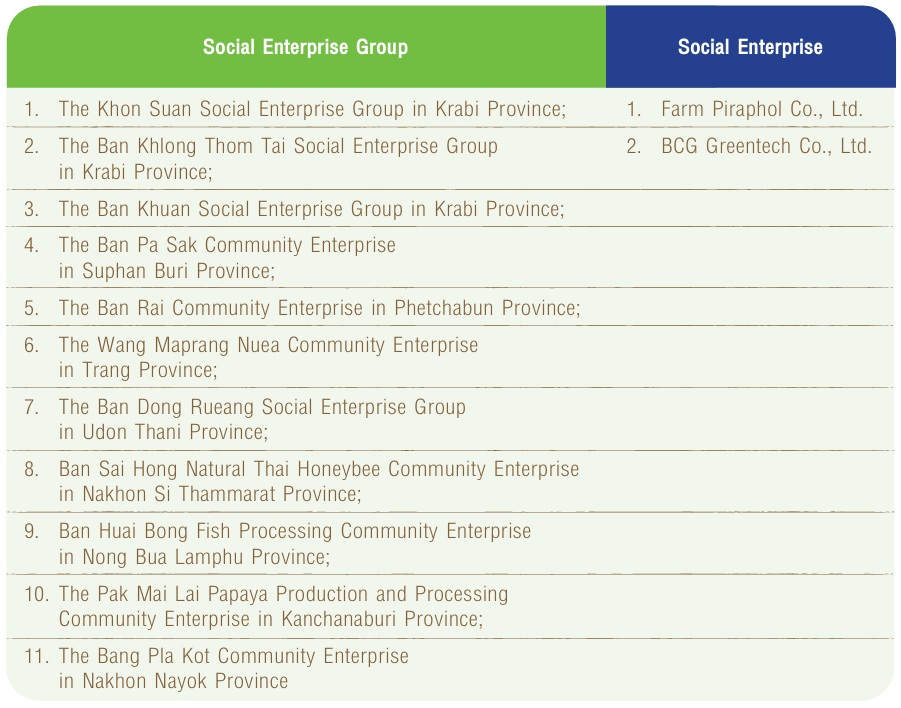
In addition, the ten EGAT Learning and Development Centers based on the Sufficiency Economy Philosophy have organized training programs on natural farming and sufficiency economy principles for youth, citizens, communities, and surrounding networks nationwide, reaching a total of 2,899 participants. Furthermore, knowledge has been expanded and applied in real community contexts among 495 participants, including communities surrounding EGAT operations and partner networks, to promote practical implementation and sustainable development outcomes.
EGAT Learning Centers
EGAT is committed to developing its learning centers as key national hubs for energy knowledge. These centers serve as platforms for transferring knowledge and experience in the field of electricity and energy, with consideration for community, social, and environmental aspects. Through modern exhibitions and a variety of learning activities, the centers provide engaging learning experiences for visitors, including youth and the general public. This contributes to enhancing comprehensive understanding of energy and supports the advancement of a sustainable “energy wisdom society.”
At present, EGAT operates a total of eight learning centers nationwide, including:
- the EGAT Srinagarind Dam Learning Center (Rajanurak) in Kanchanaburi Province,
- the EGAT Chana Learning Center in Songkhla Province,
- the EGAT Thap Sakae Learning Center in Prachuap Khiri Khan Province,
- the EGAT Headquarters Learning Center in Nonthaburi Province,
- the EGAT Lam Takhong Learning Center in Nakhon Ratchasima Province,
- the Lignite Coal Study Center Museum (Mae Moh Mine) in Lampang Province,
- the EGAT Mae On Learning Center in Chiang Mai Province, and
- the EGAT Pha Bong Learning Center in Mae Hong Son Province.
EGAT TOGETHER Initiative
The EGAT TOGETHER Initiative aims to foster a spirit of volunteerism among EGAT employees by transforming their role from “participants” into “initiators.” Employees are encouraged to apply their knowledge and expertise to design and implement volunteer activities that benefit communities, society, and the environment, while responding to stakeholder needs and aligning with the organization’s strategic direction.
EGAT provides opportunities each year for employees to form groups and propose volunteer initiatives. In 2025, a total of 14 groups were selected to receive financial support and other necessary resources. EGAT also conducted site visits to monitor and evaluate project implementation, along with knowledge-sharing forums and lesson-learned activities to enhance future development.
Over the past four years, more than 1,100 EGAT employees have participated in the initiative, forming a total of 69 groups that have implemented volunteer activities across more than 22 provinces nationwide, as well as internationally in the Lao People’s Democratic Republic. These activities include community development and public benefit initiatives, environmental conservation projects, career and skills development programs, and youth-focused activities. Examples of activities implemented in 2025 include:
- The “Energy Conservation and Efficient Resource Utilization in Educational Institutions” project by the Mok Jang Jang Rue Kwan (Light Fog or Smoke) group, which improved lighting systems, provided knowledge, and developed educational materials on energy conservation and efficient resource utilization at Ban Khao Din School, Doem Bang Nang Buat District, Suphan Buri Province.
- The “Cut, Continue, and Create Smiles 3” project by the Thunder Cut group, which provided haircutting training for secondary school students at Wat Sukkorn School, Mueang District, Samut Prakan Province, to enhance vocational skills and help reduce household expenses.
- The “Safe School Building” project by the Hug Nan group in collaboration with Nan Technical College, which provided basic electrical knowledge and repaired electrical systems at Nan Pracha Uthit School, Mueang District, Nan Province.
- The “Seniors Repair, Juniors Play” project by the RPB Volunteer Civil Engineering group, which improved playground facilities and repaired electrical systems in collaboration with government agencies, private sector organizations, and local communities at Bang Pru School, Phanom District, Surat Thani Province.
- The “Upcycling Khlong Tamru Smart City: EGAT Together to Net Zero” project by the Kid Mai Ok, Diao Bok Wan Lang (Can’t Think of a Name, Will Tell You Later) group, which transformed plastic bottles into value-added products and provided waste segregation training for the community of Khlong Tamru Subdistrict Municipality, Mueang District, Chon Buri Province.
- The “Clean Air, Bright Future: Building Air Purifiers for a Brighter Tomorrow” project by the I SEE U group, which demonstrated and provided training on assembling DIY air purifiers using locally available materials for nine schools located in the vicinity of EGAT Headquarters, Chiang Mai Province, and Mae Moh District.
Disaster Relief Assistance
EGAT provides assistance to people affected by various disasters, particularly natural disasters that cause harm and damage to lives and property, as follows:
- Delivered relief packages to flood-affected communities in 21 provinces between July and December 2025, totaling 40,760 relief packages and 489,120 bottles of drinking water.
- Provided 15,000 winter blankets to people affected by cold weather during November–December 2025.
- In collaboration with the Ministry of Energy, conducted site visits and provided assistance to flood-affected communities in Songkhla, Yala, and Surat Thani provinces during November–December 2025. Assistance included the distribution of relief packages and drinking water. EGAT also coordinated with the Volunteer Thai Engineers Foundation and network partners to implement a project to repair electrical systems for flood victims by providing financial support, electrical equipment, and personnel to repair electrical systems in buildings and residential homes in Hat Yai and Chana districts, Songkhla Province, during 5–9 December 2025.
- Provided consumer goods and essential supplies to communities in Sisaket and Surin provinces, and supported solar power generation systems and generators for security agencies to support peacekeeping operations in border areas during the Thailand–Cambodia border incident.
Community Development Project Evaluation
In 2025, EGAT conducted Social Return on Investment (SROI) assessments for key community development projects, including the Bio Way of Life for Sustainability Project in Ban Rai Community, Phetchabun Province; the Quality of Life Development Project for Communities Located Near EGAT Transmission Lines in Ban Non Yang, Selaphum District, Roi Et Province; and the Community Livelihood Development in Sirindhorn Dam and Pak Mun Dam Areas: Sirindhorn Model Project.
Of the community development projects assessed, 66.67% achieved a Social Return on Investment of more than two times the value of the investment.
Community Operation
| Item | 2025 | 2024 | 2023 |
| Coverage (%) | 100 | 100 | 100 |