Sustainability Management
Sustainability Management Process
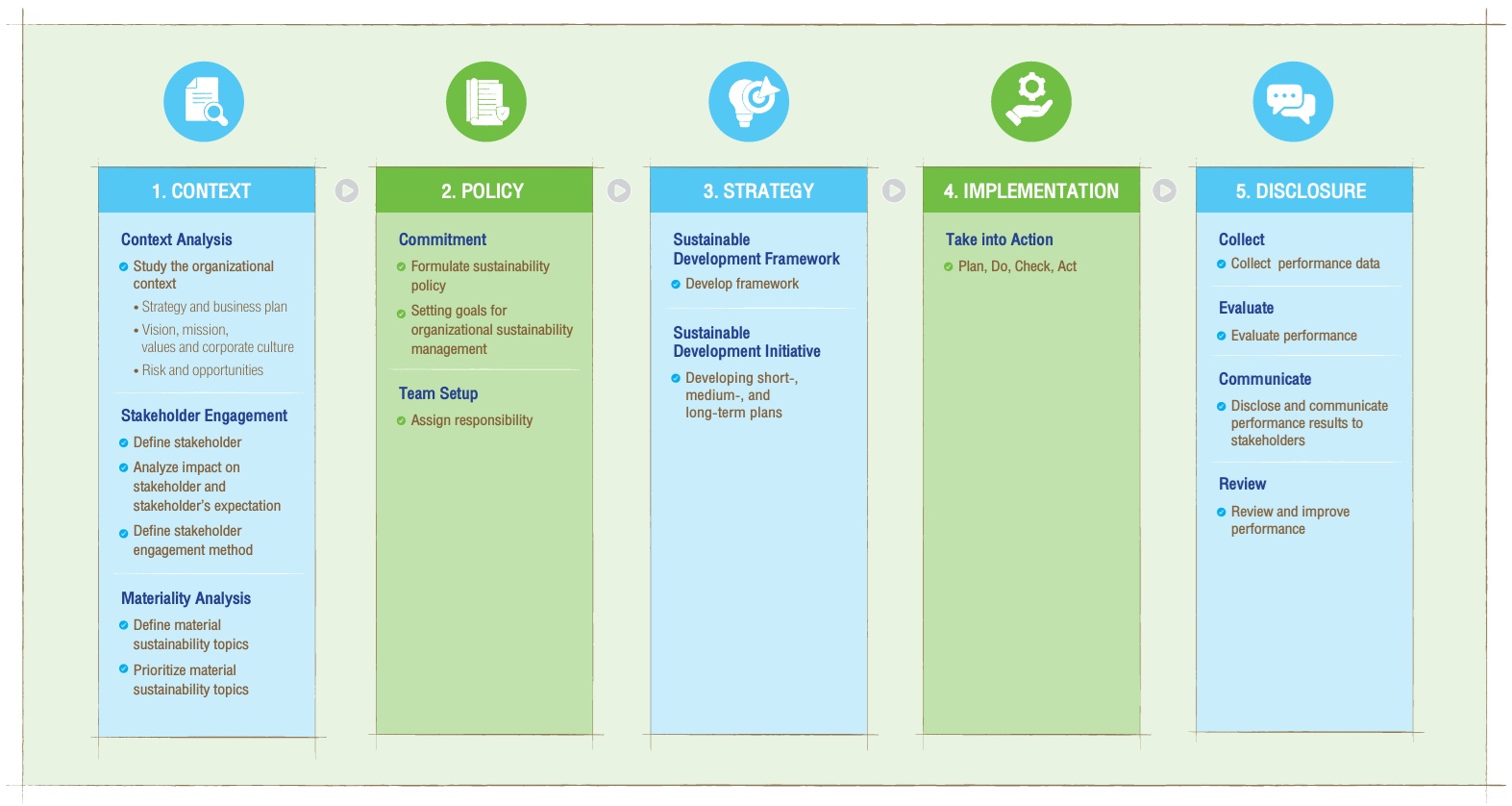
EGAT has established a systematic process to drive sustainable development as outlined below:
1. Study the organizational context, gather information and identify material sustainability topics
EGAT studies and analyzes the organization’s vision, mission, corporate culture, value chain, corporate plan, risks and opportunities, as well as industry directions and trends and government policies. This process helps provide a clear understanding of the organizational context, which will lead to the analysis of stakeholders and material sustainability topics that EGAT should prioritize and manage effectively.
2. Formulate the organization’s sustainability policy
EGAT uses the organizational context and material sustainability topics to formulate the organization’s sustainability policy and goals, demonstrating EGAT’s intention and commitment to developing and driving the organization toward sustainability. This also includes clearly assigning responsible parties and defining roles and responsibilities for driving each material sustainability topic.
3. Define the sustainability strategy
EGAT links organization-level sustainability policy and goals with the corporate strategy in order to establish the operational framework or strategy for advancing the organization toward sustainability. This may be structured across short-, medium- and long-term timeframes.
4. Drive sustainability into practice
EGAT implements sustainability plans to achieve the defined objectives and targets by applying a range of project management tools, such as Plan-Do-Check-Act (PDCA) approach.
5. Communicate sustainability performance to stakeholders
EGAT discloses and communicates sustainability performance to stakeholders through various media and channels, such as the sustainability report, to build awareness and understanding of EGAT’s operations.
Roles of the EGAT Board of Directors in Sustainability
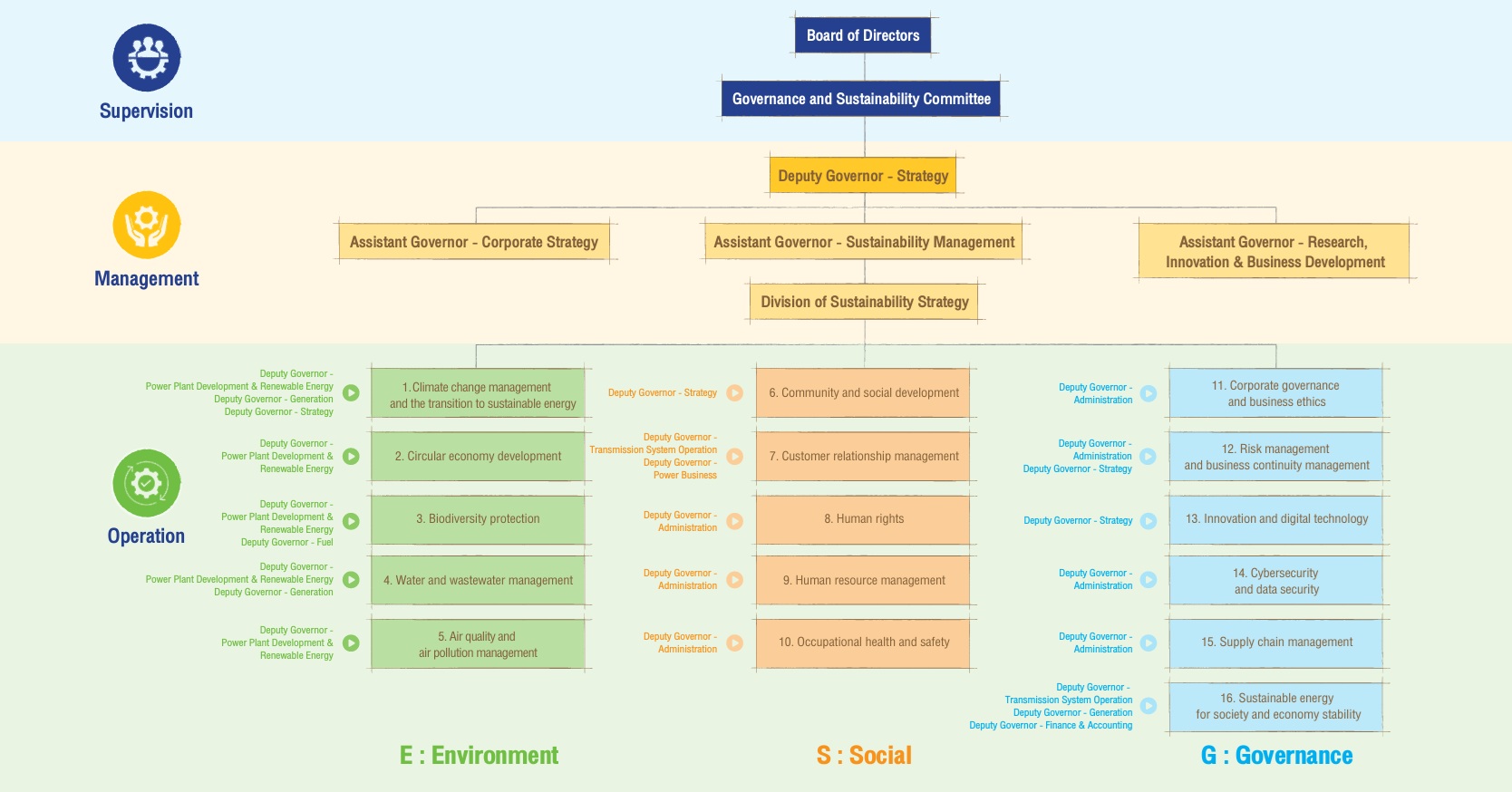
The EGAT Board of Directors is responsible for reviewing and approving significant policies and strategies, objectives, financial targets, corporate governance practices, social responsibility and environmental stewardship commitments, as well as EGAT’s operational plans. The Board also regularly monitors the implementation of approved policies and plans to ensure effective execution. In addition, the Board has established subcommittees, including the Governance and Sustainability Committee, which played a pivotal role in driving EGAT’s sustainability agenda. Key actions undertaken by the Committee in 2025 included:
- reviewing and approving EGAT’s sustainability policy;
- reviewing and approving EGAT’s sustainability manual;
- reviewing and approving EGAT’s material sustainability topics;
- reviewing and approving EGAT’s sustainability indicators and targets, including the designation of responsible units.;
- reviewing and approving EGAT’s stakeholder management master plan;
- reviewing and approving EGAT’s corporate social responsibility master plan; and
- reviewing and approving quarterly performance results on stakeholder management and corporate social responsibility, in order to oversee and monitor EGAT’s management of economic, environmental and social impacts.
Delegation of Sustainability Responsibilities
In addition, the Board has delegated authority and responsibility to the Executive Committee, consisting of the Governor of EGAT as Chairperson and the Deputy Governors as members, to manage and make decisions on various operations in accordance with the policies of the regulatory authorities, the directives of the Board and EGAT’s strategies. This includes overseeing the management of economic, environmental and social impacts arising from EGAT’s operations, and reporting performance results to the Board on a quarterly basis.
EGAT has assigned the Deputy Governor – Strategy the role of strategic planning to define the overall direction of the organization, including sustainability strategy. The Assistant Governor – Sustainability Management is responsible for overseeing the organization’s sustainability management across the organization, while the Sustainability Strategy Division is responsible for planning and managing the organization’s sustainability strategy. Responsibilities encompass establishing sustainability policies and management frameworks that align with EGAT’s corporate strategy and respond to stakeholder needs, as well as managing social, environmental and other special projects in support of EGAT’s corporate social responsibility policy and strategy. The division is further supported by dedicated departments, including the Power Plant Community Relations Department, the Renewable Power Plant Community Relations Department and the Transmission System Community Relations Department, which are responsible for implementing corporate social responsibility initiatives and engaging with stakeholders across regional areas.
The Deputy Governor – Strategy has also appointed the Corporate Social Responsibility and Corporate Communication for Sustainable Development Working Group, comprising division director-level representatives from various business units, with the Assistant Governor – Sustainability Management serving as Chairperson. This working group is responsible for reviewing and revising the Corporate Social Responsibility and Corporate Communication Master Plan, as well as setting the framework for, screening, monitoring and overseeing implementation of EGAT’s annual plans and budgets related to corporate communication, relationship building, social responsibility and donations.
Structure of Sustainability Management