
Availability and Reliability of Electricity System
EGAT is committed to strengthening national electricity security by maintaining the adequacy and efficiency of the power system in accordance with government policy and international standards. EGAT also manages electricity costs at an appropriate level to ensure access to electricity across all sectors of society and enhance the country’s competitiveness.
| Targets for 2025 | Performance |
| ● Energy Not Served (ENS) shall not exceed the five-year moving average. | ● ENS met the target. |
| ● System Average Interruption Duration Index (SAIDI) shall not exceed the five-year moving average. | ● SAIDI met the target. |
| ● System Average Interruption Frequency Index (SAIFI) shall not exceed the five-year moving average. | ● SAIFI met the target. |
| ● Availability Factor OEE (AFOEE) shall be no lower than the five-year average performance of Independent Power Producers (IPPs). | ● AFOEE met the target. |
Thailand’s Power Development Plan
EGAT serves as a representative on the Subcommittee on Load Forecast and Power Development Plan Formulation. The subcommittee is responsible for preparing long-term electricity demand forecasts for the country, which serve as a foundation for planning and formulating national electricity policies, reporting on electricity demand trends and providing technical analyses and recommendations related to demand forecasting and power development planning. These efforts aim to ensure the long-term efficiency of electricity procurement in Thailand, while maintaining power system security and supporting investment in electricity infrastructure expansion.
In addition, EGAT is responsible for developing its power plant and transmission projects included in the PDP to ensure their completion in accordance with the established schedule. EGAT also purchases electricity from domestic private producers under procurement programs announced by the Energy Regulatory Commission (ERC), and from foreign private producers as acknowledged by the Cabinet pursuant to resolutions of the National Energy Policy Council (NEPC).
National Control Center
The principal mission of EGAT’s National Control Center (NCC) is to dispatch electricity generated by power plants that have power purchase agreements with EGAT, including EGAT power plants, Independent Power Producers (IPPs), Small Power Producers (SPPs), and imported electricity from abroad, in balance with electricity demand (load). The NCC is also responsible for controlling power flows to ensure that electricity can be transmitted continuously and stably from producers to consumers, accommodating abnormal events (trip) involving equipment in the power grid, and approving the withdrawal from service or return to service of grid equipment for maintenance purposes.
The NCC’s power dispatch process begins with efficient generation scheduling based on the following priority principles:
- Power system security: The system must comply with the Contingency N-1 Criteria, meaning that if any transmission equipment or generating unit is disconnected from the system, the electricity system must still be able to supply electricity continuously, while maintaining both voltage and frequency within international standard limits.
- Compliance with agreements: Operations must comply with power purchase agreements and related policies, such as the purchase of electricity from non-firm small private producers according to the availability notified by the power plant, as well as support for future renewable power projects.
- Cost control: Once items 1 and 2 have been satisfied, the NCC dispatches power plants based on the most appropriate electricity generation costs.
To support the efficient planning of generation operations, EGAT places importance on the availability of complete and accurate tools and data, especially electricity demand forecasts, which are critical starting data for generation planning to maintain a balance between generation and load. This also includes ensuring preparedness of power plants and the power grid, covering maintenance outage planning for power plants in line with system conditions, maintaining adequate reserve margin in accordance with standard criteria, and planning equipment outages for transmission system improvements in line with system control conditions and generation plans. EGAT also assesses changing circumstances in the system and updates both current and forward-looking information, in the long term and short term, so that generation plans are aligned as closely as possible with actual anticipated conditions.
In the event of a severe emergency affecting the power system that exceeds normal control capabilities and may affect power system security, EGAT manages the risks by preparing emergency response manuals jointly with relevant public and private sector organizations, and by regularly reviewing and exercising its preparedness plans. These plans cover all activities across the value chain, from generation to transmission. Examples include emergency response plans for failures in the generation system or in the natural gas pipeline system, which supplies Thailand’s principal fuel for electricity generation, prepared in cooperation with PTT Public Company Limited and agencies under the Ministry of Energy. EGAT also has response plans for transmission system incidents that prevent control or delivery of electricity. EGAT prepares, reviews, and rehearses its Blackout Restoration Plan to restore the system to normal conditions as quickly as possible, as well as plans for various forms of disaster such as fire and flooding.
EGAT Power Generation and Transmission Development Projects
Renewable Power Plant Construction Projects
| Project | Objective | Detail | Progress in 2025 |
| Development of hydropower plants downstream of irrigation dams | |||
| Lam Pao Dam Hydropower Plant | To maximize the beneficial use of water resources and enable appropriate water management for agriculture and irrigation for communities living downstream of irrigation dams | Contracted capacity of 2.5 MW with scheduled commercial operation in November 2026 | The project was approved by the Cabinet on 18 June 2024. It has obtained an electricity generation license, completed relevant permitting processes, and is currently under construction. |
| Lam Ta Khong Dam Hydropower Plant | Contracted capacity of 1.5 MW with scheduled commercial operation in December 2029 | The project was approved by the Cabinet on 18 June 2024, and the sale of bidding documents has been completed with 4 bidders. Signing of the contract for the environmental report consultant is scheduled within January 2026. | |
| Huai Mae Tho Dam Hydropower Plant | Contracted capacity of 1.25 MW with scheduled commercial operation in February 2027 | The project was approved by the Cabinet on 18 June 2024, and a Letter of Intent (LOI) was issued to the contractor on 19 December 2025. | |
| Krasiao Dam Hydropower Plant | Contracted capacity of 1.5 MW with scheduled commercial operation in February 2027 | The project was approved by the Cabinet on 18 June 2024, and a Letter of Intent (LOI) was issued to the contractor on 9 December 2025. | |
Power Purchase Projects
| Source | Progress in 2025 |
| Independent Power Producers (IPP) | During 2019–2025, projects that signed Power Purchase Agreements (PPAs) with EGAT under the Third IPP Procurement Program had a total contracted capacity of 5,000 MW, comprising: (1) Gulf SRC Power Plant, with 4 units of 625 MW each, totaling 2,500 MW, all of which reached commercial operation in 2022; and (2) Gulf PD Power Plant, with 4 units of 625 MW each, totaling 2,500 MW, with Units 1 and 2 reaching commercial operation in 2023, and Units 3 and 4 reaching commercial operation on 31 March 2024 and 1 October 2024, respectively. In addition, principal power plants under the national PDP include: (1) Hin Kong Power Plant (replacement plant for the western region), with 2 units of 700 MW each, totaling 1,400 MW, with Unit 1 reaching commercial operation on 1 March 2024 and Unit 2 on 1 January 2025; and (2) Burapha Power Plant, with a contracted capacity of 540 MW, scheduled to begin commercial operation on 1 November 2027. |
| Small Power Producers (SPP) | Total contracted capacity amounted to 9,333.685 MW, consisting of 5,780.000 MW from cogeneration systems (5,502.000 MW firm and 278.00 MW non-firm) and 3,553.685 MW from renewable energy (638.03 MW firm and 2,915.655 MW non-firm). EGAT is currently in the process of purchasing electricity in accordance with decisions of the Energy Regulatory Commission, including: (1) 34 municipal waste-to-energy projects under the 2022 Feed-in Tariff (FiT) program, totaling 282.98 MW, of which 4 projects are SPPs totaling 98.00 MW; (2) 175 renewable energy projects under the 2022–2030 Feed-in Tariff program for non-fuel-cost groups, totaling 4,852.26 MW, of which 83 projects are SPPs totaling 4,346.22 MW; and (3) an additional 72 renewable energy projects under the supplementary 2024 round of the 2022–2030 FiT program for non-fuel-cost groups, totaling 2,145.40 MW, of which 35 projects are SPPs totaling 1,914.15 MW. |
| Neighboring countries | Total contracted capacity amounted to 6,234.9 MW, comprising electricity purchases from large power producers in the Lao PDR totaling 5,934.9 MW. During 2022–2023, EGAT signed PPAs for the Luang Prabang Hydropower Project (1,400 MW), Pak Lay Hydropower Project (763 MW), Pak Beng Hydropower Project (897 MW), and Sekong 4A and 4B Hydropower Projects (347.3 MW), totaling 3,407.3 MW of additional contracted capacity, as well as 300 MW under the Thailand–Malaysia HVDC transmission system. |
Transmission System Construction and Improvement Projects
EGAT is carrying out 18 transmission construction and expansion projects nationwide, as follows:
| No. | Project | Objective | Progress (%) | Scheduled Completion |
| 1 | TTransmission system development to accommodate the power purchase from Independent Power Producers (IPP) | Develop the transmission system to support domestic and foreign private power plants | 78.30 | December 2027 |
| 2 | Power System Improvement Project to support electricity purchase from Small Power Producers, Phase 1 (SPP1) | 11.51 | May 2026 | |
| 3 | Transmission Development Project in Nan, Phrae, and Uttaradit Provinces to support power purchase from Projects in the Lao PDR (NPUP Project) | – | December 2028 | |
| 4 | High-Voltage Substation Improvement Program to support connections under EGAT’s System Interconnection Code (SICC) | Develop the transmission system to enhance future system security and support domestic private power plants | 11.65 | December 2029 |
| 5 | Transmission Expansion Project in the Greater Bangkok Area, Phase 3 (GBA3) | Develop the transmission system to accommodate increasing electricity demand | 78.97 | December 2028 |
| 6 | Transmission Expansion Project No. 12 (TS.12) | 90.95 | December 2026 | |
| 7 | Transmission system improvement project in the Eastern region to enhance system security (TIPE) | Develop the transmission system to enhance future power system security | 65.65 | December 2028 |
| 8 | TTransmission system improvement project in the Western and Southern region to enhance system security (TIWS) | 79.71 | December 2028 | |
| 9 | Transmission system improvement project in the Northeast, Lower North and Central regions including Bangkok to enhance system security (TIEC) | 40.52 | October 2031 | |
| 10 | Transmission System Improvement Project for Lower Southern Region (TILS) | 46.20 | December 2032 | |
| 11 | Transmission system improvement project in the Upper Northern region to enhance system security (TIPN | 82.75 | December 2026 | |
| 12 | High-Voltage Substation Improvement Program in the Southern Region for Protection against Sabotage and Flooding (HSIS) | 4.31 | May 2028 | |
| 13 | Submarine Cable System Development Project to Ko Samui District, Surat Thani Province, to enhance Power System Security (SPSS) | 0.32 | June 2029 | |
| 14 | High-Voltage Substation Supply Configuration Improvement Program to enhance reliability of the Transmission System (IETS) | – | June 2028 | |
| 15 | Phase 1 Transmission Refurbishment and Expansion Project for Aging Assets: High-Voltage Substation Portion (RSP1) | Refurbish and expand aging transmission facilities | 100.00 | December 2025 |
| 16 | Phase 1 Transmission Refurbishment and Expansion Project for Aging Assets: High-Voltage Transmission Line Portion (RLP1 | 100.00 | December 2025 | |
| 17 | Phase 2 Transmission Refurbishment and Expansion Project for Aging Assets (RTS2) | 95.01 | March 2027 | |
| 18 | Long-Term Investment Plan to Support Large Electricity Users, 2026–2028 (LPLC) | Support large electricity users | – | December 2028 |
Note: Project progress as of 29 December 2025
Regional Power Trading and Energy Exchange
EGAT supports regional grid connectivity and power trading, in line with the following resolutions, strategies, and policies:
- Resolution of the National Energy Policy Council (NEPC) Meeting No. 1/2019 (16th Meeting), which called for the preparation of Thailand’s national power transmission development plan to strengthen power system security and improve transmission efficiency in support of Thailand’s role as a regional electricity trading hub (Grid Connection).
- EGAT’s strategy to become a regional electricity market administrator requires a study on the feasibility of interconnecting power systems with neighboring countries to support the future development of energy trading business.
- Thailand’s policy on electricity imports from neighboring countries under the Thailand Power Development Plan 2018–2037, Revision 1 (PDP 2018 Rev.1), which provides for electricity procurement through imports in order to promote electricity access, accommodate greater renewable integration in the power system, reduce domestic power plant investment, and enable more efficient resource allocation among countries.
EGAT engages in bilateral power trade with neighboring countries, namely the Lao PDR and Malaysia, via alternating current and direct current transmission interconnections, respectively. EGAT also participates in multilateral regional power trade with countries in the region.
A successful commercial example is the Lao PDR–Thailand–Malaysia Power Integration Project (LTM-PIP), under which the Lao PDR sold electricity to Malaysia via Thailand’s existing transmission system. Following the success of this project, participating countries agreed to expand the initiative to Singapore under the Lao PDR, Thailand, Malaysia and Singapore – Power Integration Project (LTMS-PIP).
Phase 1 of the LTMS-PIP (June 2022 to June 2024) was completed, with total electricity traded exceeding 266 million units. Under Phase 2, which provides for trading of up to 200 MW over a period of 2 years, electricity may be traded through two routes:
- Route 1: Electricity generated from green sources of up to 100 MW from the Lao PDR to Singapore through the existing transmission systems of Thailand and Malaysia. Discussions on the proposed power trade are currently underway.
- Route 2: Electricity generated from brown sources (fossil-fuel based) from Malaysia to Singapore through the existing transmission systems of Malaysia and Singapore, supplementing LTMS-PIP Phase 2 up to a maximum of 200 MW. On 20 September 2024, Tenaga Nasional Berhad (TNB) of Malaysia and SP Group of Singapore signed the Cross-Border Power Trade Interconnection Agreement (CBPTIA) to transmit electricity from Malaysia to Singapore, marking the start of LTMS-PIP Phase 2. The first trade took place on 26 September 2024 at up to 30 MW.
On 11 December 2024, at the second meeting of 2024 of the Subcommittee on Electricity Cooperation between Thailand and Neighboring Countries, the committee approved the implementation of LTMS-PIP Phase 2 and acknowledged Thailand’s wheeling charge for direct electricity trade between producers and consumers under LTMS-PIP Phase 2, as proposed by EGAT. EGAT was further assigned to negotiate the wheeling charge and prepare the draft Energy Wheeling Agreement (EWA).
At the 30th LTMS-PIP Working Group Meeting on 16 June 2025, the meeting acknowledged that electricity transmitted from Malaysia to Singapore totaled 13,230 GWh. Subsequently, on 30 June 2025, a meeting was held between Électricité du Laos (EDL), EGAT, and TNB to finalize the draft EWA. Updated wheeling charges for LTMS-PIP Phase 2 were communicated, with both Thailand and Malaysia increasing their wheeling charges from Phase 1 due to increased electricity losses and higher fuel prices.
On 14 August 2025, EGAT submitted a letter to the Energy Policy and Planning Office (EPPO) concerning the proposed agenda item for the draft EWA for LTMS-PIP Phase 2, together with related meeting documents, for consideration by the Subcommittee on Electricity Cooperation between Thailand and Neighboring Countries. On 27 October 2025, at the 3/2025 meeting of the NEPC, the wheeling charge and draft EWA for LTMS-PIP Phase 2 were approved, and EGAT was assigned to sign the EWA. The draft documents were subsequently reviewed and cleared by the Office of the Attorney General on 4 December 2025.
Modernization of Power Plants and Transmission Systems
The rapid evolution of electricity generation and consumption technologies, together with the 4D1E policy (Digitalization, Decarbonization, Decentralization, De-Regulation, and Electrification) and Thailand’s goal of achieving carbon neutrality by 2050, will lead to a greater deployment of small-scale renewable energy generation across the country. This includes Small Power Producers (SPPs), Very Small Power Producers (VSPPs), and prosumers, as well as the growing adoption of electric vehicles (EVs). As a result, electricity use behavior within EGAT System is becoming increasingly volatile and subject to rapid change. Existing power system tools and equipment may not be able to respond adequately to these developments.
As the organization responsible for maintaining national electricity security, EGAT must modernize the electricity system through Grid Modernization, implement intelligent management systems, and support regulatory and policy improvements by providing recommendations to the government. This will enable the secure and reliable operation of the power system while ensuring its readiness to accommodate future changes in the electricity industry.
EGAT’s power system modernization program, referred to as EGAT Grid Modernization, comprises five components:
- Digital Control Platform: A platform for managing and controlling the power system, covering data analytics for electricity demand forecasting, renewable generation forecasting, power plant availability and generation cost analysis, and the selection of the most appropriate power plants or tools for dispatch to respond automatically to changes while maintaining supply–demand balance under relevant constraints.
- Infrastructure Expansion Planning and Development: Planning and development of infrastructure such as power plants, transmission systems, energy storage, and technologies to serve as tools for the National Control Center (NCC) and Regional Control Centers (RCCs) to ensure future system security and stability.
- Transmission Protection, Control, Monitoring and Asset Management: Enhancing the capability to detect abnormalities in order to prevent damage in the power system, and using technology to maintain the transmission network so that it remains ready to deliver electricity reliably and cost-effectively.
- New Agreement and New Business: Revising EGAT’s rules and contractual arrangements to reduce limitations and increase flexibility in power system management.
- Support: Supporting functions through the development of data collection systems, communication systems, and cybersecurity systems, so that the future power system can operate seamlessly, securely, and automatically.
EGAT Grid Modernization Projects in 2025
| Sub-project | Details |
| Digital Control Platform | |
| Modernized National Control Center and Regional Control Center | Upgrade control center computer systems to improve operational efficiency and support evolving power systems with greater variability, enabling the forecasting of electricity demand, renewable energy generation, and power plant availability, providing generation cost calculation tools, and supporting automated dispatch decisions to maintain supply-demand balance under system constraints. |
| Renewable Energy Forecast (Ensemble) | Upgrade forecasting systems for wind and solar generation to international standards in order to support the increasing penetration of renewable power plants and align with Thailand’s medium-term smart grid implementation plan for 2022–2031. |
| Electric Vehicle Forecast | Study the charging behavior of EV users, assess the feasibility of developing EV charging demand forecasting models, develop such models, and incorporate the forecasting results into electricity demand forecasting. |
| Virtual Power Plant Platform | Develop a platform with data linkage and analytics capabilities to support the growth of Distributed Energy Resources (DERs) such as renewable generation, energy storage, demand response, and EVs, enabling the NCC to control and dispatch more effectively. |
| Infrastructure Expansion Planning and Development | |
| EGAT Energy Management System Master Control and Master Controller Solution | Develop master software and master controller hardware for the Energy Management System (EMS) to control battery energy storage systems, solar power plants, and hydropower plants from EGAT control centers or high-voltage substations, while developing EGAT employees into EMS experts (programmers). |
| Grid Scale Battery Energy Storage System (Grid Scale BESS) Program | Install large-scale battery energy storage systems integrated with EGAT’s transmission network to support renewable power procurement policy and Thailand’s smart grid implementation plan. |
| Pumped Storage Hydropower (PSH) Program | Develop pumped storage hydropower plants at Chulabhorn Dam (800 MW), Vajiralongkorn Dam (900 MW), and Katoon Dam (780 MW) to strengthen power system security and serve as energy storage facilities to support renewable energy development and Thailand’s smart grid initiatives. |
| Transmission Protection Control Monitoring and Asset Management | |
| EGAT SCADA-X | Expand installation and commissioning of the EGAT SCADA X program in EGAT high-voltage substations to enhance control system performance, and at Operation and Maintenance Workstations to improve asset maintenance efficiency, extend asset life, and maximize utilization. |
| Wide Area Monitoring System, Protection and Control (WAMPAC) Program | Develop and implement the Wide Area Monitoring System (WAMS) in conjunction with the new Energy Management System (EMS) at the control center to support power system protection and real-time control in response to increasing renewable generation, with the objective of dispatching generators or load points more effectively and maintaining overall system security and stability. |
| New Agreement and New Business | |
| New Renewable Energy Power Purchase Agreement (RE PPA) | Prepare a draft power purchase agreement (PPA) for emerging renewable energy technologies for submission to the ERC, covering procurement conditions for future renewable energy projects that would allow the control center to control or limit the rate of generation change (Minimum Ramp Rate) or require producers to provide advance generation forecasts to the NCC. |
| Grid Code | Revise and prepare three EGAT grid code documents: (1) system interconnection code, (2) system use code, and (3) system operation code. |
| Support | |
| Data Driven for Grid Modernization | Support and drive the Grid Modernization plan using the EGAT Data Platform, including: (1) development of the EGAT’s Grid Data Exchange system to create data connectivity and exchange standards for internal and external electricity system data, enabling correct, complete, secure, and sustainable integration across all departments; and (2) enhancement of the EGAT Data Platform as a central hub for end-to-end data services, covering data collection and analysis together with data governance and management to support Grid Modernization. |
Access to Energy
Thailand continues to rely on natural gas as the principal fuel for electricity generation and imports spot LNG to meet domestic gas demand. Given continued uncertainty in fuel prices, which affects generation costs, EGAT works with the government to manage fuel in order to reduce the burden of fuel costs and electricity generation costs to the fullest extent possible on a continuous basis.
In addition, at the National Energy Policy Council (NEPC) meeting held on 21 August 2025, a resolution was approved for the extension of the operational lifespan of Mae Moh Power Plant Units 8 and 11 by six years, until the end of 2031, and similarly for the extension of the operational lifespan of Nam Phong Power Plant Units 1 and 2 by six years, until the end of September 2031, in order to maximize domestic resource utilization, reduce dependence on imported fuels, and mitigate the impact on electricity tariffs for the public.
Regarding to the automatic tariff adjustment mechanism (Ft), the Energy Regulatory Commission (ERC) resolved that EGAT should temporarily absorb outstanding Ft burden on behalf of electricity users from late 2021. During 2024–2025, the ERC gradually allowed partial reimbursement of these accumulated Ft burdens in order to ease EGAT’s liquidity constraints. EGAT recognizes the importance of easing the electricity cost burden for the public. In this regard, the ERC also approved the use of clawed-back excess benefits retained by the utilities to reduce the financial burden on the public through the Ft mechanism, pursuant to the legal authority of the Electricity Tariff Regulatory Framework B.E. 2564 (2021). As a result, electricity tariffs could be reduced during the billing periods May to August 2025 and September to December 2025.
Nevertheless, EGAT continues to face risk from fluctuation in natural gas prices, which may affect EGAT’s financial liquidity and its ability to secure financing, as well as lead to higher financial costs for both independent power producers and EGAT.
EGAT is a state enterprise operating under government policy and tariff-setting guidelines for the energy business sector. EGAT’s electricity tariffs and profits are regulated by the ERC to ensure sufficient revenue only for investment and business operation. EGAT’s profits are not only remitted to the Ministry of Finance as state revenue for supporting national development purposes, but are also used for the investment of infrastructure, such as power plants, high-voltage substations, and transmission lines, without creating a fiscal burden or public debt for the country, from EGAT’s establishment to the present.
Key Performance Results
In 2025, development of EGAT’s electricity generation system, as a whole, continues to comply with the reliability criteria under the PDP2018 Revision 1, which was approved by the National Energy Policy Council (NEPC) and the Cabinet on 19 March 2020 and 20 October 2020, respectively. It is also in line with the resolution of NEPC Meeting No. 2/2023 (No. 165) held on 9 March 2023, which approved EGAT’s construction and improvement of the power transmission system to accommodate electricity procurement from renewable energy in accordance with the plan to increase clean energy generation under PDP2018 Rev.1 for the period 2021–2030 (additional revision ) and the Power Development Plan (2nd additional revision). The project budgets already approved by the Cabinet with the objective of supporting renewable energy, as well as allowing for further enhancement of the transmission system capacity, if necessary.
To maintain power system security and stability, installed capacity must exceed peak demand in order to manage force majeure event, namely power plant maintenance outages and to accommodate demand in cases where fossil-fuel power plants experience reduced generation capability or renewable plants cannot generate due to weather variability.
Details of key performance to ensure power system availability and reliability are as follows:
Contract Capacity and Electricity Demand
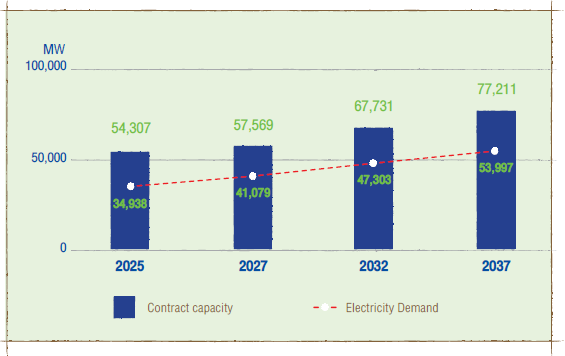
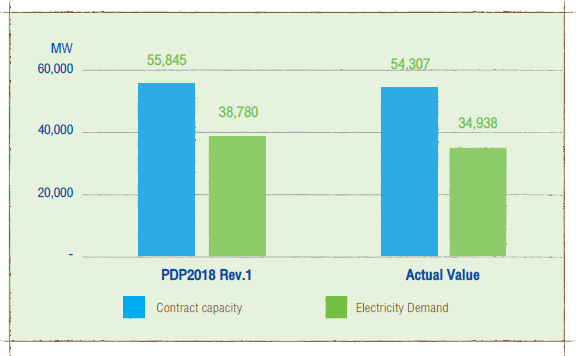
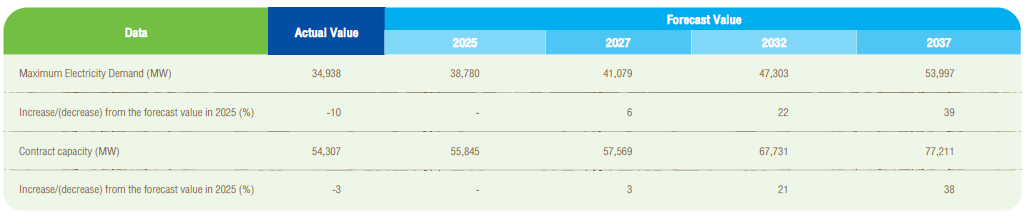
Note: Preliminary actual value as of December 2025 refers to contract capacity of EGAT system from the website of the System Control Division and information of contract capacity of
1. Department of Alternative Energy Development and Efficiency 2. Provincial Electricity Authority (PEA) 3. Very Small Power Producers (VSPPs) from the Metropolitan Electricity Authority (MEA) and the Provincial Electricity Authority (PEA) As of September 2025; Data for October–December 2025 are estimated.
Contract Capacity in 2024 and 2025 Classified by Type of Power Producer
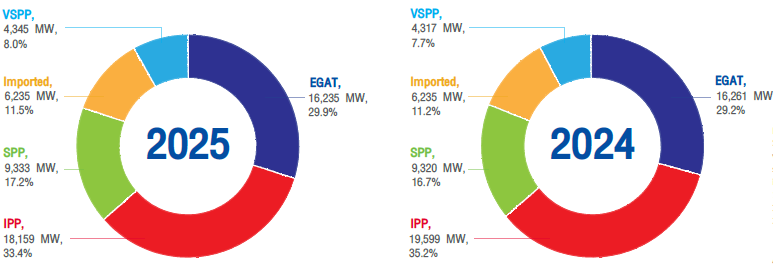
Note: Statistical Value as of December 2024, and preliminary statistical value as of December 2025 refer to contract capacity of EGAT system from the website of System Control Division and information, together with VSPP contract capacity from:
1. Department of Alternative Energy Development and Efficiency 2. Provincial Electricity Authority (PEA) 3. Very Small Power Producers (VSPPs) from the Metropolitan Electricity Authority (MEA) and the Provincial Electricity Authority (PEA) As of September 2025; Data for October–December 2025 are estimated.
Contract Capacity classified by Type of Power Producers
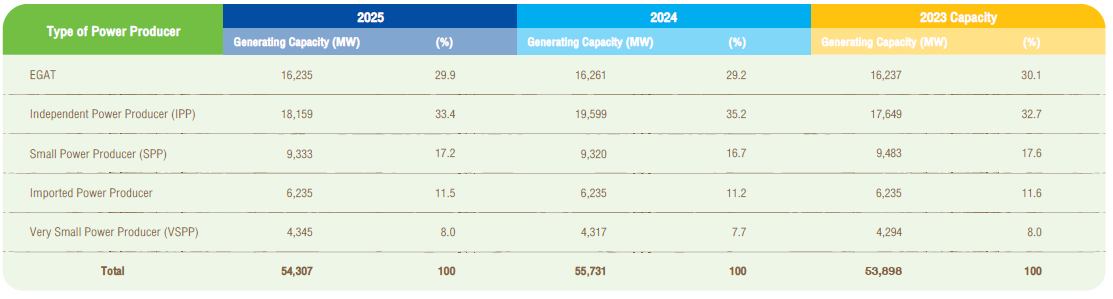
Note:
– IPP (Independent Power Producer) has the generating capacity more than 90 MW
– SPP (Small Power Producer) has the generating capacity 10-19 MW
– VSPP (Very Small Power Producer) has electricity in the system of not exceeding 10 MW
– Statistical data of December 2022 and 2023 refers to energy statistics of Thailand 2022 and 2023 of Energy Policy and Planning Office
– Statistical Value as of December 2024, and preliminary statistical value as of December 2025 refer to contract capacity of EGAT system from the website of System Control Division and information, together with VSPP contract capacity from:
1. Department of Alternative Energy Development and Efficiency 2. Provincial Electricity Authority (PEA) 3. Very Small Power Producers (VSPPs) from the Metropolitan Electricity Authority (MEA) and the Provincial Electricity Authority (PEA) As of September 2025; Data for October–December 2025 are estimated.
Indices of Performance
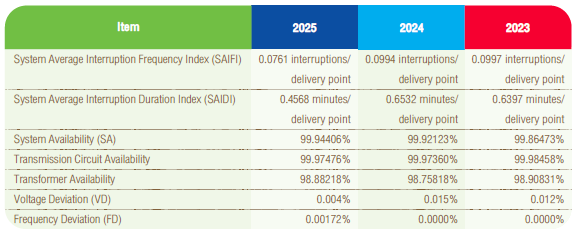
Note: Service-quality standard indices for EGAT are based solely on unplanned outages, which are used to evaluate EGAT’s operating performance.
Average Availability Factor of Power Plants
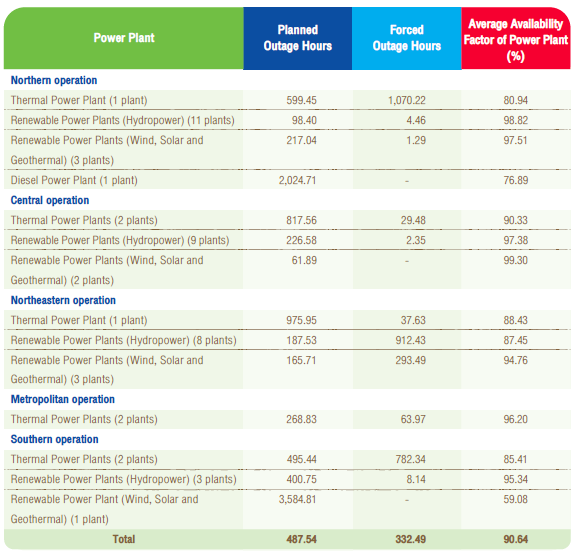
Note: – Planned outage refers to an outage scheduled in advance for an actual shutdown. – Forced outage refers to an unplanned outage requiring a power plant to cease service immediately or before the next planned outage. – Availability factor (%) = (Total hours during which the power plant was available for operation during the reporting period x 100) / Total reporting-period duration (hours).
1. Based on data from the GADS system as of 21 January 2026.
2. GADS is a database system that collects power generation data, power plant operating events, and fuel quantities used in EGAT’s power generation process.
3. EGAT power plants are grouped by operating region (there are no power plants in the Western Region), based on data from the Power System Control Division.
4. Based on the definitions and data from the GADS database system.
4.1 Planned outage hours are the sum of scheduled maintenance outage hours (Planned Outage Hours) and outage hours outside scheduled maintenance for which the shutdown date can be set more than seven days in advance (Maintenance Outage Hours) [unit: hours].
4.2 Forced outage hours are outage hours outside scheduled maintenance arising from an emergency shutdown following an alarm or a unit trip (Forced Outage Hours) [unit: hours].
4.3 Based on the power plant availability factor calculation defined by the organization, and to reflect the assets’ actual availability for dispatch and prevent stakeholders from negatively misinterpreting power plant performance, the following calculation equivalent to the GADS indicator is used:
Availability Factor = Availability Hours / Period Hours x 100 [%]
Availability Hours are the hours during which a power plant is available to generate electricity, comprising service hours during which the plant operates and supplies electricity to the system, and reserved shutdown hours during which the plant is available to operate but is not dispatched; Service Hours + Reserved Shutdown Hours [unit: hours].
4.4 Overall performance is calculated on a time basis and then weighted by the Gross Maximum Capacity (GMC) of each generating unit (Capacity Weighted Average).