
Innovation and Digital Technology
EGAT is advancing toward becoming an innovation-driven organization by promoting learning and innovation development to keep pace with technological change, while supporting research and development in the energy sector and enhancing the effectiveness of digital technology operations to drive the organization toward sustainability.
| Targets for 2025 | Performance |
| ● 100% achievement of the Data-driven for Grid Modernization initiative to support the security of the national power system. | ● 100% achievement of the Data-driven for Grid Modernization initiative to support the security of the national power system. |
Policy and Commitment
EGAT has established a digital policy to ensure the appropriate management of digital technologies in support of present and future business needs. Moreover, EGAT has formulated an innovation management policy that covers the creation of an environment conducive to knowledge sharing, creativity, motivation, and adequate resource allocation, together with the development of knowledge and innovation management systems, as well as the leveraging of intellectual property derived from personnel experience. This is pursued in parallel with the development of personnel competencies to become innovators, as well as the continuous development of knowledge networks and expert communities both within and outside EGAT.
Operational Structure
EGAT has established the Digital Technology, Knowledge Management, Research and Innovation Committee, appointed by the EGAT Board of Directors, to oversee and formulate policy, review the master plan and annual action plans, as well as monitor and offer recommendations on EGAT’s digital technology, knowledge management, and innovation to ensure their effectiveness.
The Office of the Assistant Governor – Digital Technology is responsible for driving digital technology operations, including the development of digital technology strategy and architecture in alignment with organizational policy, goals, and strategic plans; digital governance; data management and data analytics; project management; digital system development and administration; digital infrastructure management; digital system operation and maintenance; digital service management; and cybersecurity and information security. EGAT also has related committees and working groups such as the EGAT Digital Working Group, the EGAT Data Services Working Group, the Enterprise Systems Working Group, and the EGAT Geographic Information Working Group.
EGAT’s innovation structure consists of three responsible entities: (1) Policy-level innovation management, referring to the innovation committee, which is responsible for formulating policies, master plans, and action plans to oversee, promote, and drive innovation management (2) Operational-level innovation management, comprising the Research and Innovation Division, innovation units at division level, and EGAT business units, which are responsible for market-related activities, including market testing, identifying investment opportunities, and supporting the scale-up and commercialization of innovation outputs. (3) Innovation development, involving all EGAT employees, who are encouraged to contribute ideas, identify problems, and participate in innovation development through various activities and channels
Management
EGAT has established a digital technology strategy through the preparation of the EGAT Digital Master Plan, which is aligned with the corporate plan and key government policies. The strategy emphasizes the application of digital technology across the organization and defines digital technology management and development processes covering: (1) Governance of digital technology and the organization’s digital action plans; (2) Application of digital technology throughout the organization, including enterprise architecture analysis and design, efficient project and digital operations management, and quality management; (3) Integration and collaboration of data and operations across units; (4) Data governance and management of organizational big data; (5) Information security management; (6) Business continuity management and system availability; and (7) Resource utilization management and selection of environmentally friendly technologies.
Additionally, EGAT regularly reviews its Innovation Master Plan and innovation management guidelines, which consist of four main elements: governance structure, management system, operational support system, and performance monitoring, evaluation, and reporting system. EGAT has designed an Innovation Framework that is aligned with the principles of ISO 56002 and the Corporate Innovation System (CIS) under the State Enterprise Assessment Model (SE-AM). EGAT has also prepared the EGAT Innovation Management Manual to serve as a framework for innovation management.
EGAT has continuously carried out research and innovation activities. From 2006 to 2025, EGAT supported a total of 813 research and development projects for educational institutions, research institutes, and various organizations. In 2025, EGAT supported 34 new research and innovation projects and disbursed a total research and innovation budget of 135.669 million baht.
Budget for Research and Development and Innovations
| Item | 2025 | 2024 | 2023 |
| Budget disbursement (million baht) | 135.669 | 214.358 | 359.742 |
| Support of Research and Innovations (projects) | 34 | 19 | 26 |
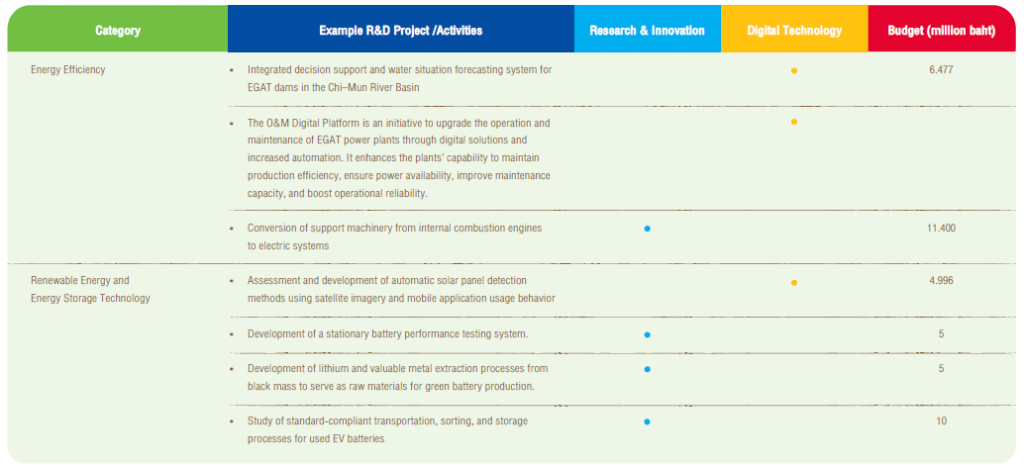
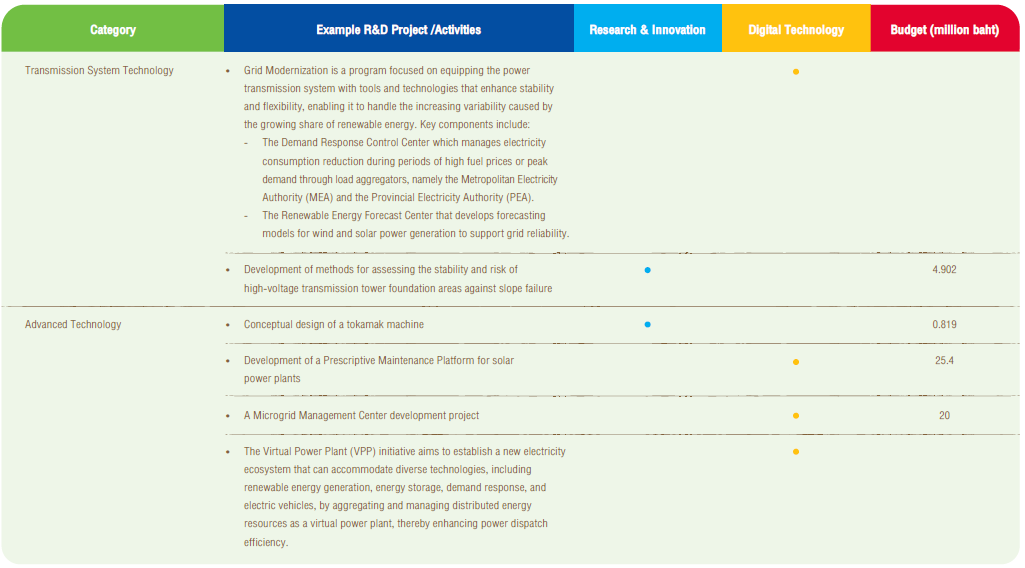
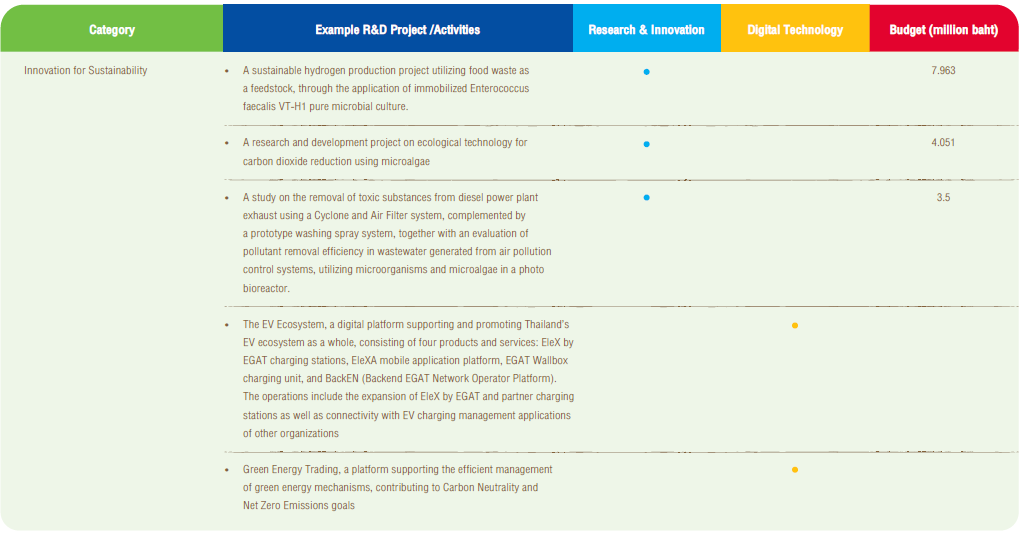
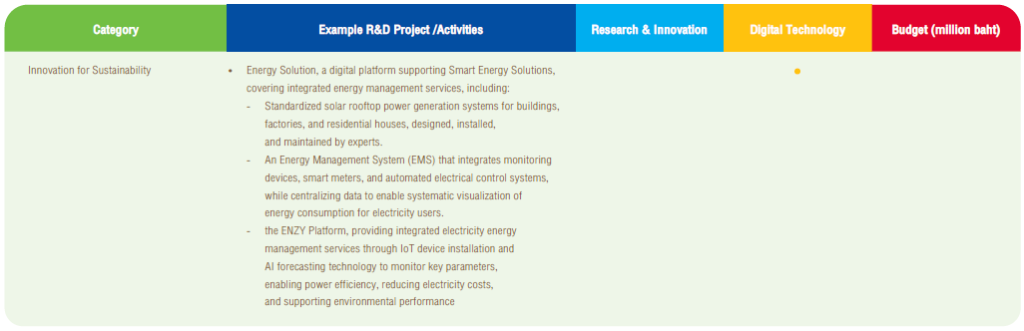
Key operations in research, innovation and digital technology in 2025
Intellectual Property Management
EGAT manages intellectual property throughout the entire process, from promoting awareness among personnel of the importance of creating and registering intellectual property, to providing advice on rights relating to creative works, examining the novelty of innovations prior to disclosure, and preparing documentation and coordinating applications for protection in various forms, such as patents, petty patents, copyrights, trademarks, and trade secrets. This enables EGAT’s research and innovation outputs to receive legal protection, prevents imitation, enhances credibility with business partners, and creates opportunities for commercial technology transfer. A strong intellectual property management system also helps motivate personnel to continuously invent and develop new works.
During 2024–2025, EGAT managed 233 intellectual property works. In 2025, EGAT sought new intellectual property protection for 23 works, comprising 1 patent, 12 petty patents, 5 copyrights, 4 product designs, 1 trademark.
Enhancement of Personnel Capabilities in Knowledge Management and Innovation
EGAT has established Knowledge Management and Innovation Facilitators (KM-Inno FA) to act as representatives in communicating, promoting, and publicizing the organization’s knowledge management and innovation activities, while also supporting knowledge management, research and innovation, and creativity initiatives. For example,
- EGAT InnoVenture project, which provides a platform for employees to present innovative and digital ideas to solve problems and enhance internal work efficiency through various activities such as the KM-INNO FA Workshop under the theme “Driving Ideas, Encouraging Creativity, Sparking Innovation”, the InnoVenture Boot camp, and Demo Day.
- “Show and Share Innovation 2025”, was organized to showcase the capabilities of research, invention development, and power innovation from Thailand’s three electricity utilities (EGAT, PEA, and MEA), while facilitating knowledge sharing on energy technologies among these organizations to enhance the quality and reliability of the power system in response to the digital energy era and the transition to a low-carbon society.
Collaboration in Research and Innovation Development
EGAT supports the development of energy-related research and innovation in collaboration with both internal and external experts, including academic institutions and research organizations at both national and international levels. In 2025, EGAT established research and innovation partnerships with six universities, as follows:
| Cooperation Agreement | Objective |
| 1. EGAT – Kasetsart University (3-year term) | To study, develop, and conduct research in energy through knowledge exchange and innovation creation that supports sustainable energy technology development, including in areas related to communities, society, the environment, and biodiversity, in order to enhance the capability to create highly efficient products or systems that respond to diverse user contexts. |
| 2. EGAT – Mahidol University (Faculty of Science) (3-year term) | To study, research, and develop research projects to foster academic, research, and innovation collaboration, and the development of personnel and students, in support of future advancement of the country’s science and technology. |
| 3. EGAT – Chulalongkorn University (3-year term) | To study, develop, and conduct research in energy and key technologies such as Grid Modernization, Battery Energy Storage Systems (BESS), Hydrogen, CCUS, and electricity generation-related technologies such as SMR, SCO2, Plasma & Fusion, and Renewable Energy, through knowledge exchange and innovation creation that supports sustainable energy technology development, as well as community, social, and environmental dimensions. |
| 4. EGAT – Prince of Songkla University (3-year term) | To study and develop projects aimed at advancing knowledge, academic capability, and technology, including in energy, community development, society, the environment, and biodiversity, in order to extend research and innovation outputs for beneficial application |
| 5. EGAT – Thammasat University (3-year term) | To study, develop, and conduct research in energy through knowledge exchange and innovation creation that supports sustainable energy technology development. |
| 6. EGAT – Burapha University (3-year term) | To study, develop, and conduct research in energy and electricity generation-related technologies through knowledge exchange and innovation creation that supports sustainable energy technology development. |